Author: Goldberg Jones

  • No-Fault Divorce in Oregon: What are Grounds for Divorce?

    When you read about divorce, you often see “irreconcilable differences” listed as the root cause of the separation. You hear this phrase frequently because the term comes from the modern “no-fault” divorce code.

    What Is No Fault Divorce?

    It’s been in the news lately, but what exactly does no-fault divorce mean?

    Just like it sounds, no-fault divorce means, legally speaking, neither party shoulders the blame for the end of a marriage. No one has to prove the other was in the wrong. In short, to divorce, the law only requires that one of you wants out of the marriage.

    No-Fault Divorce in the U.S.

    The first no-fault statute in the U.S. was passed in California in 1969. Over the following 50 years, all 50 states either removed fault-based divorce from their code or added a no-fault “irreconcilable differences” clause to their code.

    Therefore, in every state, you have the option to choose a no-fault divorce. However, in a few states, fault-based divorce remains on the table. In these jurisdictions, obtaining a no-fault divorce is much more challenging if one party contests the divorce.

    No-Fault Divorce in Oregon

    So, when asking if Oregon a no-fault divorce state, the answer is: Yes.

    The current statute in Oregon provides that a divorce may be rendered when:

    “[I]rreconcilable differences between the parties have caused the irremediable breakdown of the marriage.”

    Furthermore, Oregon removed all fault-based divorce standards.

    This means the courts will not consider evidence of acts of misconduct in divorce proceedings. This can and does still pop up in child custody matters if you show the relevance of such evidence.

    Similarly, when dividing property between spouses, the courts no longer consider evidence of misconduct or fault. Instead, any assets or debts acquired during your marriage are divided under the state’s equitable distribution model.

    Related Reading: How Can Adultery Affect a No-Fault Divorce?

    Fault-Based Divorce

    Traditional fault-based grounds for divorce are very similar to breach of contract actions. The most common grounds for divorce included:

      • Adultery.
      • Sexual deviance.
      • Mental illness.
      • Abandonment or desertion.
      • Criminal conviction.
      • Substance abuse.

    Arguments For No-Fault Divorce

    Proponents of no-fault divorces argue that fault-based divorces are an anachronistic legal concept. They take the stance that those laws no longer reflect the reality of marriages in modern-day America.

    Additionally, they feel removing fault from divorce proceedings also removes much of the anger, bitterness, and acrimony that attends a divorce where one party must show the other was to blame.

    Arguments Against No-Fault Divorce

    Opponents of no-fault divorces cite the shift as the cause of the rising divorce rate, an increase in poverty for women, and a decrease in society’s value of marriage as a social pillar.

    Before the passage of the no-fault code, divorce was only allowed when the parties could demonstrate fault or blame in the marriage, such as abuse, adultery, or infertility. However, over the past 50 years, the laws across the country shifted from fault-based to no-fault divorces.

    Related Reading: How Long Does Divorce Take in Oregon?

  • Is January Really Divorce Month?

    Key Takeaways:

    • January is often referred to as “Divorce Month,” but that name may be somewhat misleading.
    • The pressures of the holidays often play a role in the timing and decision to divorce.
    • Data supports a seasonal pattern, not a single month.
    • January is often the starting point for divorce, not the finish line.
    • “Divorce Season” may be a more accurate term than “Divorce Month.”
    • Another “Divorce Season” occurs in late summer.

    Fair or not, nicknames often stick and are hard to shake. A pesky moniker can follow you around for years. How many of us have a friend who will forever be “Tiny” or “Lefty” or “Gonzo” for some long-forgotten reason?

    This doesn’t just happen to people, either. To some, the month of January, all 31 days, has become known as “Divorce Month.”

    The basic idea is that couples push to end their marriages in the days that immediately follow the New Year. But the question arises: Is this an accurate nickname? Is January really divorce month?

    As is so often the case, the answer to whether or not January really is divorce month is complicated.

    The truth is a little bit yes and a little bit no. One report may have put it best when describing January not necessarily as divorce month, but as a time of year when couples examine divorce options.

    divorce month januaryWhy Is January Considered Divorce Month?

    How did January become known as divorce month?

    Several factors contribute to an increased number of people dissolving marriages this time of year.

    In some instances, people put off acting on a decision they have already made, waiting to get past the stress and chaos of the holidays. With family around, the kids out of school, and celebrations galore, some people put on a brave face and power through. Maybe you tried for one last happy holiday and didn’t want to ruin the festive mood.

    In other cases, holidays may be the proverbial straw that broke the camel’s back. All the additional anxiety and activity put increased pressure on a marriage. For a relationship that’s already in trouble, a big fight or a strained family gathering may become a breaking point.

    Financial concerns also often play a part. Holiday spending and expensive travel arrangements can exacerbate money concerns and lead to friction. Some people get significant end-of-year bonuses. And by waiting until the new year, the divorce doesn’t impact taxes from the previous one.

    For some, it’s as simple as looking for a fresh start in a new year. This is the time when people enact change and attempt to fix problems in their lives. A broken marriage is certainly a problem that needs fixing.

    Related Reading: How Long Does Divorce Take in Oregon?

    divorce month januaryEvidence of Divorce Month

    For years, there’s been plenty of anecdotal evidence to label January divorce month.

    Divorce attorneys often note an increase in calls and new cases when the calendar turns over. Some people merely feel out the process and explore their options at first, while others are ready to dive in and get things done right now.

    Increasingly in recent years, several studies have lent statistical backing to support divorce month claims. A 2016 report from the University of Washington examined data about divorce filings over 14 years. From 2001-2015, researchers noted a consistent rise in divorce proceedings beginning in January.

    The researchers behind this study also note the influence holidays have on this pattern. They refer to “culturally sacred” times as a reason why people often put off divorce. Many feel doing so during the holidays is “inappropriate, even taboo.” No one wants to be the jerk who ruined Christmas for everyone.

    Related Reading: Common Divorce Mistakes and How to Avoid Them

    divorce month januaryDivorce Month is a Misnomer

    Calling January divorce month is, however, a bit of a misnomer.

    While the number of divorce filings does indeed begin to climb during the first month of the year, according to the data they don’t peak until March.

    In reality, there’s a simple explanation for this: divorce takes time. It’s called the divorce process for a reason.

    A great deal goes into ending your marriage. This is often the time of year when people get the ball rolling. You explore your options, meet with and potentially hire a divorce lawyer, make a plan for the kids, set up a support network, save money, and generally establish a strategy to move forward.

    It’s not simple or fast. While you may begin in January, you likely won’t finish until much later.

    In certain situations, you can handle a divorce quickly. These are usually shorter marriages with little shared property and no children. Cases like this are often straightforward. But the more you have to contend with, the more complicated your case becomes. This means it takes longer.

    Establishing custody, creating parenting plans, dividing commingled assets, and more all take time and energy. You have to collect documents, deal with discovery, and you may wind up in mediation, arbitration, or even go to trial.

    If you and your spouse are on the same page, this can go smoothly, but the more conflict, the more complicated and time-consuming things become.

    In a practical sense, January isn’t necessarily divorce month so much as it’s often the starting line. You feel out the situation, look into possible options, and begin the process. Online searches for terms like “divorce,” “child custody,” and other family law topics also rise during this season.

    Related Reading: Fathers’ Rights And Child Custody: With Infographic

    divorce month januaryJanuary Isn’t Alone

    Though January hogs the spotlight as divorce month, it’s not alone. The UW study demonstrates that the January through March window shows a 33% increase in divorce filings.

    But that isn’t the only time the numbers spike.

    The period from July through August follows a similar arc. During this span, the numbers experience a 30% bump, rising steadily and then peaking as the summer winds down.

    This time of year features many similar strains and stresses as the holidays. The kids are out of school and need care, many families go on vacation, and the pressures mount on fragile marriages. Also, when it comes to deciding custody, the courts are often reluctant to make a big change during the school year. In many cases, it makes sense to hash things like that out during breaks.

    The decision to end your marriage is huge. It impacts every facet of your life. And like most big decisions, it’s important to consider the timing.

    January is a popular time to start the process of dissolving your marriage but to call it divorce month isn’t entirely accurate. At the same time, it isn’t entirely wrong. Perhaps talking about “divorce seasons” offers a more accurate description than a single divorce month.

    Other Reading: How Do Major Purchases Affect Divorce?

  • How Does Adultery Affect Divorce in Oregon?

    Many factors contribute to a divorce. Adultery is often a big one.

    Infidelity often has a destructive, devastating effect on a marriage. It’s a huge breach of trust. In many cases, perhaps even most, if one spouse is caught having an affair, that’s it, call it a day.

    But, despite the catastrophic impact on your relationship, how does cheating affect the actual divorce process? Or, does it? The real answer surprises many people.

    Does Adultery Affect Divorce?

    Depending on where you live, adultery may or may not play a part in your divorce settlement.

    In certain states, adulterers can’t receive spousal support after the dissolution of a marriage. For others, it influences the division of property.

    North Carolina, for example, even has “homewrecker” laws. In one case, a man sued the man with whom his wife cheated. The courts awarded the plaintiff $750,000.

    From a divorce perspective, the consequences vary greatly from state to state. But here’s what adultery may mean for your settlement if you live in Oregon.

    Related Reading: How is Debt Divided in Oregon?

    What Is A No-Fault Divorce?

    Before diving into the deep end, it’s important to understand no-fault divorce. And to know that Oregon is a no-fault divorce state.

    What that means is fairly simple:

    • There are no grounds for divorce.
    • And no specific criteria must be met.

    Basically, you don’t have to prove either spouse caused the marriage to fail. All that’s required is for one party to declare “irreconcilable differences,” with no hope of resolving these issues, and the state will grant a divorce.

    There are no “innocent” and “guilty” parties. As long as you are legally married, meet the Oregon residential requirements, and follow the proper procedures, you’ll get your divorce.

    Because of this, whether or not one spouse cheated often proves largely irrelevant when it comes to ending your marriage. Legally speaking, the why is not the important part of this equation.

    The simple fact that one party wants to end the union is the key element. That doesn’t necessarily mean infidelity doesn’t factor into the process at all, as it can impact other areas. However, exactly how much varies on a case-by-case basis.

    Related Reading: How Long Does Divorce Take in Oregon?

    Adultery and Property Division

    Since Oregon is a no-fault divorce state, adultery has no bearing on whether or not you will be granted a divorce. Unless it directly relates to a decision the court has to rule on, you may not even be allowed to testify about any wrongdoings on the part of your spouse.

    One place where adultery may play a part is when it comes to the division of property in the divorce settlement. Emphasis on the word “may.”

    This usually only happens when cheating directly impacts the financial circumstances of one party. For example, if an affair incurred expenses.

    Did your ex rack up extensive travel and hotel fees? Did they empty shared bank accounts to buy significant gifts? In cases like these, the court may consider adultery when dividing assets.

    Even if this is the case, however, it can be difficult to prove in court.

    Related Reading: How Oregon Divides Property in Divorce

    Adultery And Spousal Support

    As with property division, we rarely see cases in which adultery affects spousal support awards.

    Proving financial hardship as a result of infidelity can be tough. You must confirm the impact in a concrete way for the court. There are instances where this happens, however.

    If you can show that your spouse drained your savings in the course of an affair. Perhaps infidelity led directly to a large debt. In those situations, the court may order temporary spousal support.

    Another situation is if cheating caused significant emotional distress. So much so that it impacted your ability to work and hold a job. That might also play a role, though again, demonstrating this in a tangible way often proves difficult.

    Related Reading: How Is Spousal Support Calculated in Oregon?

    Adultery and Child Custody

    Exactly how much, if at all, does adultery factor into decisions regarding child custody in Oregon?

    Much like in other areas, for this to have a significant influence on guardianship and visitation, you must show that cheating directly impacts one party’s ability, or inability, as a parent.

    Perhaps you can prove that, because of an affair, one spouse showed a pattern of neglect. Did your ex choose infidelity over parental duties? Did they forget to pick up the kids at soccer practice because they were engaged in an illicit tryst? The court may consider that when it comes to custody.

    Again, you must concretely show that a spouse’s adultery impaired his or her ability as a parent. If not, it may not be presented as relevant information in the case at hand.

    This door also swings both ways. While you hope to demonstrate that infidelity impacts your ex’s capacity to care for a child, your ex may attempt to show that it does not.

    As traumatic and damaging as adultery can be to a marriage, and as great an impact as it can have on the state of the relationship between two people, it may not have a massive effect on your actual divorce proceedings.

    If you demonstrate a definite, causal connection between infidelity and things like financial hardships or parenting ability, the court may take it into consideration.

    If not, it usually has much less influence than you might initially expect.

    Related Reading: The Cost of Divorce: What You Should Know

  • How Has the Divorce Rate Changed With Each Generation?

    The common refrain is that the divorce rate in the United States hovers around the 50% mark. Except it doesn’t, and never has. The hows and whys of that, however, are a topic of conversation for another time.

    In reality, the divorce rate is lower than in years and has been on a steady if gradual decline. An interesting exercise is to look at divorce by generation and investigate the changing views.

    How Attitudes About Divorce Have Changed Over Generations

    There are currently six living generations of Americans.

    Attitudes towards families and marriage form a definitive piece of each, and examining them provides some insight. There are, of course, exceptions to every rule, and we’ll be looking at these in broad strokes.

    Not every member of every generation fits each mold exactly. However, looking at the larger trends of the divorce rate by generation lets us see how prevailing norms evolve.

    Related Reading: 8 Ways to Prepare for Divorce

    GI Generation

    Also widely called the “Greatest Generation,” these are people born from 1901-1926. They experienced two World Wars firsthand, as well as the Great Depression.

    One of the defining characteristics of this era is a strong sense of duty, civic responsibility, and right and wrong.

    This black-and-white sense of the world extends to how the GI Generation looks at divorce. They take the “‘til death do us part” segment of the wedding vows very seriously. Marriage is a commitment, for life.

    Things like divorce or having children out of wedlock are simply not acceptable. Divorce carries a stain and stigma. Because of these dominant cultural and societal attitudes, fewer people from this age group stray from that path.

    Related Reading: How Political Differences Can Cause Divorce

    Mature Silents

    Born between 1927 and 1945, the generation known as the Mature Silents, or Silent Generation, carry similar touchstones of the previous age group.

    Many fought in the Korean and Vietnam Wars, but they also experienced the post-World War II economic boom. Though there were the first rumblings of the Civil Rights movement and feminism, it was generally a time of great conformity.

    This conformity also extended to how we look at divorce by generation in this instance. In general, the husband worked, primarily at one job for one employer his entire career, while the wife stayed home with the kids. Marriage is, again, usually for life, and things like divorce and having children outside of marriage are simply not acceptable.

    Related Reading: Ways to Save Money During Divorce

    Baby Boomers

    Born just after World War II, in the years 1946-1965, the Baby Boomers are the generation that embraced rock and roll, social change, credit cards, and television. With 77 million people, it’s also one of the largest single generations in history.

    Widely regarded as self-centered, this age group, also nicknamed the “Me Generation,” pushed against traditional social constructs and boundaries.

    Their attitudes toward divorce, marriage, and families reflect this changing tide.

    When breaking down divorce by generation, this is where the biggest shifts occur. In large part, this is due to the sheer size of this demographic. There’s a lot of them, so they carry a lot of weight.

    Women of this generation entered the workplace in previously unheard-of numbers. This created more dual-income households. But it’s also the first era where mothers weren’t as pervasive in a child’s life as before.

    For the first time, divorce became more widely accepted. Because of an increased emphasis on individuality, divorce was viewed as an acceptable way to deal with an unhappy marriage.

    You were no longer expected to stick it out through irreconcilable differences. This era also began the age of no-fault divorce, where you can end a marriage simply because you want to, without providing cause.

    Even as the Baby Boomers continue to age, they divorce more than any other age group. Between 1990 and 2012, the divorce rate for 55 to 64-year-olds more than doubled. For the 65-and-older crowd, that number more than tripled.

    Related Reading: Divorce or Legal Separation?

    Generation X

    Since Baby Boomers had fewer children than their parents, Generation X, those born between 1965 and 1980, is smaller than its predecessor.

    More cynical about society and authority, they have an eye on individuality and are likely to change careers multiple times over their lives. They’re also unique in numerous ways when we look at divorce by generation.

    As Baby Boomers focused on career advancement, both parents were likely to work. Since divorce became commonplace, Generation X was the first era where having divorced parents was normal. It wasn’t strange or bad; it was just a common fact of life.

    For the most part, Generation X responded to this by staying married. More people also put off marrying or decide not to marry at all. But once they say “I do,” GenXers remain married at higher rates than the preceding generation.

    Roughly 70% of marriages that took place in the 1990s made it to their 15th anniversary. This is up from 65% for those in the ‘70s and ‘80s. And that number continues to increase. The divorce rate for couples married in the 2000s is even lower.

    Related Reading: How to File for Divorce in Oregon

    Millennials

    Millennials, born between 1981-2000, rely more heavily on technology than any previous generation. This is the age group that grew up almost entirely with computers in homes and schools.

    Generally raised by involved parents, they have a reputation for being overindulged and entitled.

    As far as marriage and divorce compared to other generations, Millennials continue some of GenX’s trends. Their marriage rate is the lowest in years at 26%. Compare that to 36% for Generation X, 48% for Baby Boomers, and 65% for the Mature Silents. Millennials put marriage off, or avoid it altogether, at higher rates than ever.

    Many attribute this to changing gender roles, increased focus on education, and financial concerns. It’s more common than ever for a couple to live together and even have children and start families without marrying.

    Again, this represents a generational evolution in ideas of marriage and family.

    Related Reading: Creating a Divorce Strategy

    Gen Z

    There’s one more age group, those born after 2001, known widely as Generation Z. There were a few other nicknames along the way, but this one stuck.

    They’ve never known a world without cell phones, laptops, or video games. Within these numbers, there are even wider demographic changes.

    2006 saw a record number of births, even more than the start of the Baby Boom. So, Gen Z is a big generation.

    Consequently, whatever patterns and attitudes emerge will have a substantial overall impact. We’ll have to wait and see if they continue to push off marriage and if divorce rates continue to decline. However, if they continue Millenial trends, their divorce rate seems likely to remain relatively low.

    While it’s still too early to look at Gen Z for much concrete information, they promise to be an interesting lens through which to view divorce by generation.

    Related Reading: Is the 50% Divorce Rate a Lie?

  • Prepare For Your Initial Divorce Consultation

    Getting divorced is a daunting task and an intimidating proposition. In many, if not most cases, hiring an experienced attorney to help you through the process is a sound strategy. However that in itself can be an overwhelming experience.

    Finding the right lawyer—more specifically, the right lawyer for you and your case—is tough. (Remember, the best divorce attorney means different things in different cases.) And then you have to meet with your attorney. Fortunately, there are things you can do to prepare for your initial consultation.

    Remember You’re Both Meeting For The First Time

    Remember, while you’re meeting this attorney for the first time, the initial consultation also presents the opportunity to meet you. This provides a chance for both sides to make sure this is a good fit.

    How this goes often differs from firm to firm. You may meet with a solo practitioner, where he or she is the only attorney.

    When it comes to firms with multiple lawyers, things vary even more. For example, at Goldberg Jones, after an initial consultation with our managing attorney, he pairs you with the attorney he feels is the best fit for you and your case. However, having someone you’re comfortable with representing you is key.

    Related Reading: How Long Does Divorce Take In Oregon?

    Make Sure You Can Communicate

    Divorce is a traumatic time. You may not always think straight. Being able to clearly and accurately communicate your needs is a huge and important part of the process. If your lawyer doesn’t know what you want, it makes their job, and getting an optimal outcome, that much more difficult.

    Your initial consultation is the time for you to gauge this connection. You don’t need to be best friends, but your divorce lawyer is someone you’ll work with closely. Making sure you can accomplish that and effectively communicate is vital to the success of your case.

    Related Reading: Does Oregon Have Common Law Marriage?

    Is Your Lawyer Experienced In Your Area?

    Some attorneys work in many areas. But it makes sense to hire a divorce attorney if you’re going through a divorce. Even then, there’s a great deal of specialization and the initial consultation is also the time to suss that out.

    • Do you have kids? If so, a lawyer with experience in child custody cases may be best suited to your case.
    • Is there a great deal of shared property to divide? An attorney with knowledge of high-asset divorces might be just what you need.

    Whatever specific criteria you have, make sure to ask the right questions. It can relate to taxes, military service, pensions, or maybe you and your spouse own a business together. It’s crucial to find a divorce lawyer who fits the needs and criteria of your case.

    Related Reading: Preparing for Divorce

    Ask About Fees And Billing

    An initial consultation is a perfect time to discuss fees. Part of finding the right divorce attorney is being able to afford the right divorce attorney. Ask your lawyer to explain their billing practices right out of the gate.

    • Do the costs break down hourly, by the half-hour, in 15-minute increments?
    • Do they also charge for work done by support staff or for making phone calls and sending emails?

    No one wants to get blindsided by a massive, unexpected bill.

    Related Reading: What is the Average Cost of Divorce in Oregon?

    What To Bring To An Initial Consultation

    The more information a divorce attorney has, the better idea you’ll get about your case. As such, you likely want to bring a number of documents to your initial consultation.

    • Recent tax returns and lists of assets and financial obligations are pretty standard—the more complete your records, the better.
    • Bank statements, credit card statements, mortgages, and auto loans are also typical.
    • If you own a business with your spouse, bring any corporate tax records.

    Basically, collect any pertinent documents ahead of time. This includes prenuptial agreements, any existing court orders, and more. It’s better to have information and not need it than the other way around.

    Related Reading: 5 Financial Mistakes that Damage Divorce Settlements

    After The Initial Consultation

    After your initial consultation, you also have a great deal to do. There are forms to file, a spouse to serve (or service to respond to), and a case to prepare for. If you hire a lawyer, he or she will most likely guide you through this tricky process. That said, there are ways to prepare that may streamline things and cut costs.

    • Educate Yourself: Whether you go through mediation, arbitration, or a full trial, it’s good to know what to expect. Understanding the process, you can do some of the legwork. Knowing what’s going on also helps ease stress in a stressful time.
    • Organize: Collecting and organizing all the pertinent documents and information saves you and your divorce attorney time and hassle. And if you gather financial papers, tax documents, and more, that’s time your lawyer doesn’t have to spend chasing them down and billing you.
    • Know When To Fight And When Not To: Know going in what’s important to you and what you can live without. Divorcing couples often spend time and money battling over items of little consequence. Do you really want to spend $500 in attorney’s fees fighting over a shoebox full of cookie cutters? It happens more often than you think. Don’t be a pushover, but know where you’re willing to compromise. Save the fight for things that have a lasting and substantial impact.
    • Your Lawyer Is Not Your Therapist: Your divorce lawyer is on your side and probably knows many intimate details about your life. But that doesn’t mean you should use your time together like a therapist’s couch. You want them to empathize with you, yes, but they’re not for unburdening your deepest thoughts. That gets expensive and it’s not why you hired a legal professional in the first place.

    Your initial divorce consultation with an attorney can be a stressful experience. But knowing what to expect ahead of time goes a long way toward preparing you. It helps to know what to ask and what to look for. This is by no means an exhaustive list, but hopefully, it provides a better idea of what’s in store.

    Related Reading: Community Property Vs Equitable Distribution: What’s The Difference?

  • Is the 50% Divorce Rate a Myth?

    One statistic tossed around frequently is that 50% of all marriages end in divorce. The number varies a bit, but the gist is that roughly half of weddings have a corresponding divorce waiting.  As ubiquitous as this figure is, many just accept it as fact. But is the legend of the 50% divorce rate real or a myth?

    Has the Divorce Rate Ever Been 50%?

    So, has the divorce rate ever been 50%?

    Nope. Never was. Despite the fact that many hold this wisdom as truth, experts have debunked this figure multiple times over the years.

    But if the 50% divorce rate is a myth, the question remains, how did it get started? How did it become so widely agreed upon and acknowledged?

    50 percent divorce rate

    How The 50% Divorce Rate Myth Began

    It began in the Baby Boomer generation when people born in the post-World War II years began to marry and start families.

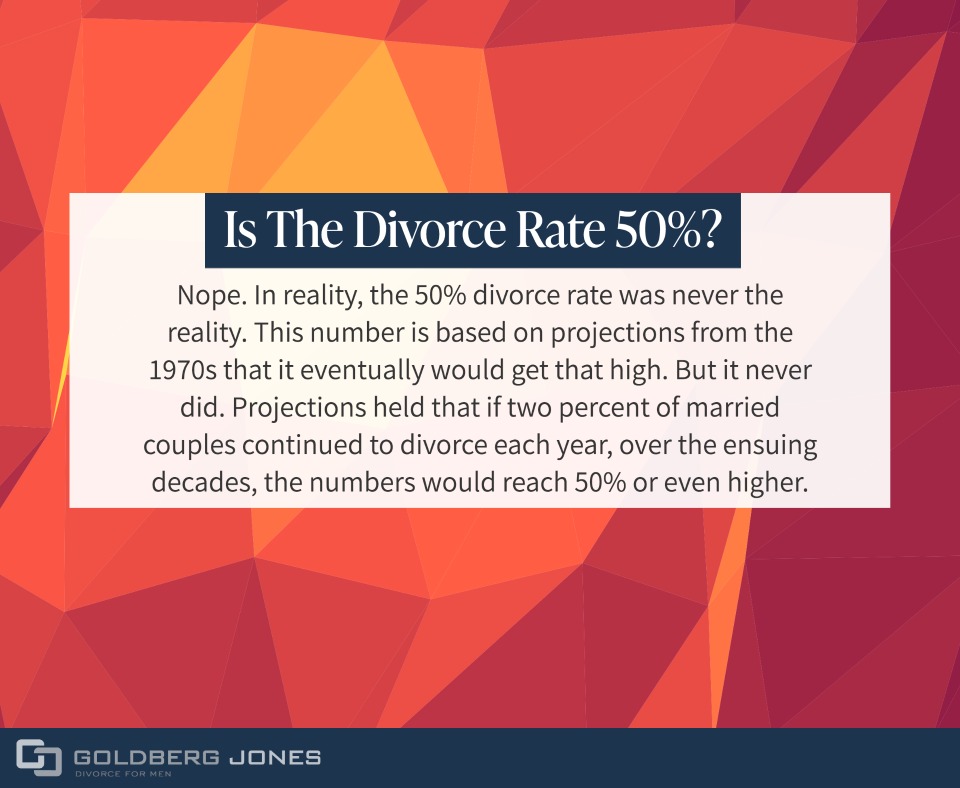
    In reality, the 50% divorce rate was never the reality. This number is based on projections from the 1970s that it eventually would get that high. But it never did.

    Projections held that if two percent of them continued to divorce each year, over the ensuing decades, the numbers would reach 50% or even higher.

    The number itself was never a static amount or representative of current marriages. The projections simply suggested it could get that high if this one trend continued.

    It’s information that was widely misinterpreted and misquoted. Over time, it was shared so often, with such an air of authority, we collectively stopped questioning it.

    The Divorce Rate Is Actually Dropping

    The divorce rate did spike in the 1970s and early ’80s, especially after no-fault divorce became the law in most states.

    Under these regulations, neither party has to prove the other is at fault to dissolve a marriage. Instead of blaming one another to determine who is responsible, the only qualifier is that if one party wants a divorce, they can divorce.

    Though there was an initial upswing in the dissolution of marriage, the divorce rate has declined steadily since.

    Leaving out unions where one spouse died, approximately 70% of marriages in the 1990s made it until their 15th anniversary. This is up from around 65% in the ‘70s and ‘80s.

    Moving into the 2000’s, the divorce rate was even lower.

    A number of factors contribute to the waning divorce rate:

    • People wait until later in life to marry and have children.
    • Long-term, non-marital relationships grew more common.
    • Cohabitation before marriage became more conventional.
    • Expectations of what marriage is and what people want and expect out of it changed.

    Unlike many previous generations, marriage isn’t a given.

    People aren’t in as great a hurry to get hitched and settle down, and many marriages are less rushed. These days, people often push off tying the knot and take their time to get it right.

    Essentially, if people are going to go through the effort of marriage, many want to make sure it sticks. And the divorce rate appears to reflect these trends.

    Related Reading: Breaking Down Rates Divorce By Generation

    Divorce Rate Statistics

    While the divorce rate, as a whole, has been in steady decline, that’s not consistent across every demographic and population.

    Factors like education level and race are big indicators of a potential divorce. The Washington Post published the following data based on a 2014 survey:

    Related Reading: Odd Divorce Laws From Around the World

    Education And Its Effect

    According to these numbers, 39% of men with a high school education or below will divorce in their lifetimes. The same is true of 37% of women.

    With a college education, the divorce rate drops substantially, to 28% for men and 29% for women. Those numbers hold fairly steady for advanced degrees, landing at 26% for men and 30% for women.

    Related Reading: Is January Really Divorce Month?

    Race And Divorce

    The divorce rate fluctuates wildly across racial boundaries:

    • 36% of white men and 38% of white women will dissolve a marriage.
    • Those numbers are slightly higher for Black men and women, who both clocked in at 42%.
    • Hispanic men and women are less likely to divorce, at 27% for men and 30% for women.
    • Members of Asian communities are least likely to divorce, with just 16% of men and 18% of women ending marriages.
    • Native American population is the most likely, with 44% of men and 45% of women ending a union.

    As you can tell, there are a ton of statistics floating around about divorce and the divorce rate. If you look hard enough, you can find numbers about how almost any factor you can think of impacts marriage and marital happiness.

    There are big ones like race, economics, and views on children. But there’s also data on cigarette consumption and what role your Facebook relationship status plays in the likelihood of divorce.

    While these statistics provide a broad-spectrum, big-picture look at the divorce rate, every individual situation is different. There’s a great deal of crossover from one group to the next.

    Just because you fit into one category or another, doesn’t mean your marriage is doomed. And just because it’s been said many times, doesn’t mean 50% of marriages end in divorce.

    Related Reading: Breaking Down Rates Divorce By Generation

  • Awesome Dad Movies For Any Holiday

    Baseball Movies
    Halloween Movies
    Thanksgiving Movies
    Father’s Day Movies

    Baseball Movies

    We may not have an MLB team in Portland yet, but that doesn’t mean we’re not fans. One of our favorite traditions is watching movies with the old man. Following that line of thinking, here are some of our favorite baseball movies to watch with the big guy.


    Field of Dreams

    baseball movies fathers day1989’s Field of Dreams is tailor-made for Father’s Day. When a mysterious voice compels an Iowa farmer (Kevin Costner) to build a baseball diamond in the middle of a cornfield, it kicks off a saga that’s more about fathers and sons than it is home runs or corn or even the ghost of Shoeless Joe Jackson. This all-time sports movie classic offers wide-eyed enthusiasm, the search for atonement, and indelibly etched “If you build it, he will come” into the pop culture lexicon.


    Bull Durham

    baseball movies fathers dayWith Bull Durham, Field of Dreams, and For the Love of the Game, it’s safe to say Kevin Costner has a thing for using baseball as a storytelling mechanism. Writer/director Ron Shelton deftly balances drama, humor, and heart in telling the tale of a perennial minor leaguer (Costner), his dumb-but-absurdly-talented protégé (Tim Robbins), and the superfan who unites them (Susan Sarandon). Philosophical, romantic, and raucous, there’s a good reason—many actually—why Bull Durham stands as one of our most beloved baseball movies.


    Pride of the Yankees

    baseball movies fathers dayA biopic celebrating the life of Lou Gehrig, The Pride of the Yankees chronicles the rise of New York’s legendary first basemen. It follows him from his young days, dreaming of playing in the big leagues, to his death at 37 from the neurological disease now commonly known as Lou Gehrig’s Disease. A romantic tale of a passionate dreamer, this is one for baseball fans and non-fans alike. Fun fact: Babe Ruth plays himself, as do Gehrig’s Yankee teammates Bob Meusel, Mark Koenig, and Bill Dickey. This is a great watch for Father’s Day.


    Major League

    baseball movies fathers daySimultaneously a rousing underdog story about a bunch of has-beens and never-weres and a manic comedy ride, Major League stands as one of the most entertaining of all baseball movies. When a former showgirl trophy wife inherits the Cleveland Indians, she assembles a team so bad she’ll be able to relocate to Miami. But things don’t go exactly as planned and rowdy hilarity ensues.


    The Sandlot

    baseball movies fathers dayThe Sandlot has become a modern classic for a certain generation. Following a group of neighborhood kids, the story deals with friendship, growing up, and changing times. It also dives into the idea of broken homes, blended families, and coming to terms with the often harsh realities we face every day in family law. But most of all, it’s a love letter to baseball and the sense of wonder it can still create.


    Moneyball

    baseball movies fathers dayWho knew a movie about baseball statistics would be so good? But here we are. Moneyball traces Oakland A’s general manager Billy Beane (Brad Pitt) as he, hemmed in by finances, turns to in-depth statistical analysis to build a winning baseball team. Many teams have since imitated his approach with great success, but at the time it represented a radical departure from the way things were done. And sure, it follows the rise of someone who dared buck the system, but the heart of the film lies with Beane’s relationship with his young daughter as they try to navigate the ups and downs of being a single parent. Ideal to check out on Father’s Day.


    Bang the Drum Slowly

    baseball movies fathers dayOne of the greatest baseball movies ever, 1973’s Bang the Drum Slowly also helped launch the career of Robert De Niro. It tells the story of the friendship between a star pitcher (Michael Moriarty) and his dim-witted catcher (De Niro) as they navigate the ups and downs on the baseball diamond and the latter’s terminal illness. Think a baseball version of Brian’s Song. Heartbreaking and heartwarming in equal measure, get ready to pretend you have something in your eye.


    The Natural

    baseball movies fathers dayIf you ever nicknamed a baseball bat “Wonderboy,” you already know The Natural. Barry Levinson’s Oscar-nominated adaptation of Bernard Malamud’s novel traces the career of Roy Hobbs (Robert Redford). A young prodigy, off-the-field events derail his path to the majors, though he finally gets his chance in the bigs much later in life. A sincere homage to the national pastime, embodying both the pain and joy we endure as fans, this is a modern fable about the American dream.  It’s a Father’s Day favorite around these parts.


    42

    baseball movies fathers dayJackie Robinson was a hero, both on and off the baseball field. There’s a reason why Major League Baseball permanently retired his number.

    42 dramatizes his struggle and the obstacles he faced to become the first African American to break the color line and play in the majors. Full of great performances from Chadwick Boseman and Harrison Ford, among others, it’s not only a great baseball movie but an important history lesson and illustration of how sports can drive change.


    The Bad News Bears

    baseball movies fathers dayThe cranky, crotchety, reluctant coach is a sports movie staple. But few are as enduring or memorable as Walter Matthau’s Morris Buttermaker in The Bad News Bears.

    The alcoholic, pool-cleaning, former-minor-league-pitcher becomes the unlikely father figure to the ultimate little league team of misfits and miscreants. Rude, crude, and a ton of fun, it’s a movie both kids and adults can love, even if younger viewers may pick up a blue word here or there. It’s a perfect watch for Father’s Day.

    Halloween Movies

    It’s the spookiest time of the year. The leaves have changed, the nights grow longer, and Halloween lurks right around the corner. There’s always been something about this season that leads people to marathon horror movies. Maybe it’s the general darkness, that the weather’s bad so staying inside makes more sense, or it’s just fun to sit through cinematic scares. It’s also a game the whole family can play. With that in mind, here are ten of our favorite horror movies to watch with the kids!

    Most of these skew more towards the family-friendly side of things, but some may be a bit too intense for younger kids or those who scare easily. You know your children and what is and isn’t too far for them. Still, it’s probably best to watch these before you commit to showing them to your brood.


    halloween moviesThe Goonies

    Okay, The Goonies may not be a traditional horror movie. But there are caves, villains, thrills, and pirates, so we’ll let it slide this time. This swashbuckling adventure puts the kids front-and-center in the action and still holds up even more than 30 years later.


    halloween moviesThe Monster Squad

    Another film that gives the kids their day, The Monster Squad has become a bona fide cult classic over the years. A group of horror-obsessed pre-teens face off with classic genre villains like Dracula, the Mummy, and Gill-Man. And we learn one very interesting, and useful, fact about Wolfman.


    halloween moviesLabyrinth

    Legendary rock star David Bowie working with Muppet creator Jim Henson seems like a match made in heaven. Their 1986 dark horror fantasy Labyrinth follows a young girl as she enters a magical world to rescue her kidnapped baby brother from Bowie’s Goblin King. Weird and wondrous, this makes for perfect viewing this time of year.


    halloween moviesBeetlejuice

    In a career full of strange, off-kilter films, none are as strange and off-kilter as Tim Burton’s Beetlejuice. Funny, creepy, and dripping with imagination, a recently deceased ghost couple (Alec Baldwin and Geena Davis) make the mistake of hiring a crude, crass, over-the-top spirit (a gleefully unhinged Michael Keaton) to haunt the insufferable yuppies who’ve taken up residence in their house.


    halloween moviesThe Nightmare Before Christmas

    Is The Nightmare Before Christmas a Halloween movie or a Christmas movie? This debate has raged since the Tim Burton-produced, stop-motion animated, fantasy musical came out in 1993. But you know what, we like to think of it as both. It’s delightful and spooky, but not too spooky for the youngsters, and makes for a perfect watch right now.


    halloween moviesGremlins

    Another entry that doubles as a Christmas movie in a pinch, Gremlins taught us many important lessons. Chief among these is that post-midnight snacks have serious consequences. It may not revolve around Halloween proper, but Christopher Columbus’ 1984 creature feature totally shares the spirit of the season.


    halloween moviesParaNorman

    A blend of horror, humor, and heart, ParaNorman follows a young protagonist who talks to ghosts and battles zombies, bullies, and adults who think he’s weird. Laika’s animated adventure tackles deep themes and social issues, but is also, most importantly, a rollicking good time rendered in spectacular stop-motion animation.


    halloween moviesThe Addams Family

    The Addams Family was already a classic long before the 1991 cinematic reboot. But Barry Sonnenfeld’s adaptation is one of the rare birds that spoofs the original at the same time it lovingly embraces the macabre, subversive elements in ghoulishly fun ways.


    halloween moviesHocus Pocus

    What would a Halloween movie list be without at least a few witches? Hocus Pocus, the tale of a trio of 300-year-old witch sisters transported to 1993, has become a full-blown cult classic and a frequent addition to many seasonally appropriate watch lists. Sure, it’s silly, but it provides some delightful spooks and scares for parents and kids alike.


    halloween moviesYoung Frankenstein

    You may not think of Mel Brooks as being wholesome family fare. But while the filmmaker’s trademark blue humor is on full display in his 1974 riff on the Frankenstein story, much of it is subtle enough to fly over the heads of younger audience members. It’s Halloween viewing you can enjoy along with your kids.

    There are, of course, countless other films to help prepare for Halloween. You can marathon all eight (!) Harry Potter movies to stay busy leading up to October 31. It’s the Great Pumpkin, Charlie Brown, is a Halloween classic. And it’s never too early to introduce the kids to the timeless Universal horror movies like Dracula, Frankenstein, The Wolf Man, The Mummy, and the rest.

    Related Reading: More Posts for Everyday Dads

    Thanksgiving Movies

    Thanksgiving is destined to look different for many of us this year thanks to COVID-19. But fear not, we can still indulge in two of our favorite pastimes: eating too much and watching movies.

    So you and your pod just polished off a 17-pound turkey, the last bit of cranberry sauce in town, and all the potatoes Idaho produced last year. Football’s done for the day. There weren’t any parades to gawk at. What do you do now?

    As the tryptophan courses through your veins and your body tackle the Herculean task of digestion, physical activity is off the table. Watching a movie sounds just about perfect, doesn’t it? And we’ve got some Thanksgiving-specific suggestions.


    Planes, Trains, and Automobiles

    What’s not to love about John Hughes working with Steve Martin and John Candy? This mismatched cross-country road trip pairs Martin’s fastidious advertising executive with Candy’s slovenly traveling salesman. And the result has become a true Thanksgiving classic.


    A Charlie Brown Thanksgiving
    It may not be a full feature-length motion picture, but what would any holiday be without a visit from Charlie Brown and company? Poor Chuck, he just doesn’t get that buttered toast and popcorn are not traditionally found on a Thanksgiving table. But fortunately for everyone’s favorite mopey sad-sack, Snoopy and Woodstock have his back.


    Rocky

    You may not immediately think of Rocky on Thanksgiving—unless your extended family is prone to fisticuffs at holiday gatherings. But as Sylvester Stallone’s title character meets Adrian, the love of his life, on Turkey Day, it makes the cut.

    And hopefully your uncle Paulie doesn’t chuck the bird out into the alley. Side note: Rocky 2 also works, as the rematch between Rocky Balboa and Apollo Creed goes down on Thanksgiving.


    Spider-Man

    As he usually appears in balloon form during the Macy’s Parade, Spider-Man already has a connection to Thanksgiving.

    But if you need more, Sam Raimi’s 2002 superhero flick features a Thanksgiving dinner scene where the friendly neighborhood wall crawler’s nemesis, Norman Osborn, stops by only for Aunt May to chide him for digging in too early.


    Alice’s Restaurant

    Novels, short stories, and TV shows are all fodder for film adaptations. But you don’t often hear about songs being translated to the big screen. Arthur Penn’s 1969 Alice’s Restaurant is an exception. Taken from star Arlo Guthrie’s narrative folk song, the film tells the tale of a Thanksgiving day dump run gone awry.


    Grumpy Old Men

    Walter Matthau and Jack Lemmon play lifelong neighbors and, most importantly, rivals. This running feud only deepens when the retired TV repairman and former teacher spot their new neighbor (Ann-Margret) and the competition for her affection reignites old hostility.

    This rivalry involves a particularly contentious, and hilarious, Thanksgiving dinner.


    The Big Chill

    Holidays and old friends gathering together go hand in hand. Lawrence Kasdan’s 1983 The Big Chill may revolve around a funeral, but one of the key shared memories revolves around a flashback to a gluttonous Thanksgiving feast.


    Dutch

    The holidays are a time when we mend fences and bridge gaps, and 1991’s Dutch does both. Ed O’Neill’s gruff construction worker must ferry his girlfriend’s son from a preppy boarding school in time to make Thanksgiving.

    A crass comic road trip, it has enough heart to warm the whole family on a chilly fall day.


    Miracle on 34th Street

    More commonly associated with a different holiday, most people forget this Christmas classic actually kicks off on Thanksgiving.

    And to be fair, once Thanksgiving is in the books, it’s usually a mad dash to the Christmas finish line, so it’s never too early to get in a jolly frame of mind. (And this one involves lawyers, so we’re all in on Miracle on 34th Street.)


    Paul Blart: Mall Cop

    As you’re stuffed to the gills and on the verge of falling asleep, stimulating psychological fare might be out of the question.

    Thankfully there’s Paul Blart: Mall Cop. More of a Black Friday movie, this will either get you in the mood to brave the early morning shopping throngs or convince you to stay home altogether. Either way, it’s a win.


    Father’s Day

    Finding Nemo

    Fathers will do just about anything for their children. This has been fuel for films since day one, and, at least cinematically speaking, it’s not a trait exclusive to humans. As illustrated by Disney and Pixar’s 2003 Finding Nemo, this also includes animated clownfish voiced by Albert Brooks. When his son is taken from their home on the Great Barrier Reef, timid Marlin (Brooks) sets out on a dangerous journey across the open ocean to rescue his boy.

    That’s a simple formula, but the movie is anything but. Full of adventure, gorgeously rendered visuals, and engaging and sympathetic characters, Finding Nemo is inventive, engrossing, funny, and full of both humor and heart like few films out there, animated or otherwise. If that’s not perfect for Father’s Day, what is?


    Mrs. Doubtfire

    Again, fathers going to great lengths for their children is a theme on full display in Chris Columbus’ 1993 comedy Mrs. Doubtfire. After a bitter divorce that sees him being cut out of the lives of his children, down-on-his-luck actor Daniel Hillard (Robin Williams) disguises himself as a female housekeeper in order to keep an eye on and spend time with his kids.

    This movie takes a lot of grief and has been spoofed and parodied all over the place, but at its core, it’s an inherently sweet family picture. It can be a bit sappy and light at times, but anchored by a Robin Williams performance that is simultaneously manic, overboard, and genuinely sweet, it’s well worth another watch.


    Father Of The Bride

    Vincent Minnelli’s 1950 Father of the Bride is, itself, a fantastic movie and well worth your time—it does star Elizabeth Taylor and Spencer Tracy, and was nominated for multiple Academy Awards, after all. But for the purposes of this list, we’re talking about 1991, Steve Martin-starring remake. Watching our kids grow up, it’s hard to imagine them as independent adults, fully capable of looking after themselves.

    At the heart of this film is the realization every parent eventually comes to, that our kids no longer need us, that they’re just fine on their own. That’s a hard truth that George Banks (Martin) and his wife, Nina (Diane Keaton), have to accept building up to their daughter’s wedding. That, of course, is easier said than done, all manner of shenanigans ensue, and the result is delightful.


    Indiana Jones And The Last Crusade

    good fatherIf you’ve ever wished your dad was a heroic adventurer, a peerless intellectual, or just all-around cool, Indiana Jones and the Last Crusade is the wish-fulfillment movie for you. If your father just so happens to be Sean Connery, even better. Steven Spielberg’s 1989 film, the third in the franchise, sees everyone’s favorite archeology professor, Indiana Jones (Harrison Ford), on one last epic quest—at least until Kingdom of the Crystal Skull rolled around.

    This time, however, things are a bit different as he teams up with his father, Henry (Connery), to find the Holy Grail. This has everything you want, from exotic locations to fighting Nazis to high adventure where the very fate of the world hangs in the balance. If you can’t go on an actual epic quest with your dad on Father’s Day, watching this may be the next best thing.


    Paper Moon

    Not all cinematic father figures are actual biological dads. Such is the case with Peter Bogdanovich’s 1973 Paper Moon. Whether or not Ryan O’Neal’s Depression-era con man, Moses Pray, is the father of his real-life daughter Tatum O’Neal’s young orphan, Addie Loggins, is a question that hangs over the movie. But whether or not there are any real blood ties, their bond is true, and the two form an unlikely partnership.

    A sweet and mischievous road movie that follows the mismatched pair, it’s also the story of a life-altering journey for both. At 10-years-old, Tatum O’Neal became the youngest Oscar-winner to date for her turn as Addie, and the subsequent estrangement of the father and daughter in the real world adds an especially poignant edge to Paper Moon. And there’s hillbilly wrasslin’, what’s not to love?

  • Ways To Prepare For Divorce

    Divorce is a huge undertaking. Depending on the situation, it can be a long, in-depth process full of forms, hearings, meetings, and more. While no two cases are ever identical, and no single recommendations fit every situation, there various ways to prepare for divorce.

    Some of these are simple and may sound obvious. Others may be less intuitive. What they can do is make you as ready for what’s ahead as possible and hopefully provide some peace of mind.

    How Can I Prepare for Divorce?

    If you’re heading for divorce, there are steps you can take ahead of time to streamline the process and better prepare. Not an all-encompassing list by any means, but here are actions you can take to increase your chances for an optimal outcome.

    1) Educate Yourself

    Divorce laws vary a great deal depending on which state you live in. Perhaps the best advice out there is to familiarize yourself with the specifics of your home state. The more you know, the better prepared you’ll be.

    For example, Oregon is an equitable distribution state. This means property acquired during a marriage is viewed as belonging to the spouse who earned it. In a divorce, assets are divided in a fair and equitable manner between you and your ex.

    This is just one of many laws that may be different. Custody, spousal support, and other laws often differ from state to state. It benefits you and your case to learn the particular regulations where you live.

    Related Reading: Creating a Divorce Strategy

    2) Create A Plan For The Kids

    If there are children involved in your divorce, things become increasingly complicated. As this can be a long, contentious legal process, you want to create a plan to ensure they’re cared for. Examine your state’s rules and regulations governing child custody and child support.

    Your kids have the same needs and require the same care during and after a divorce as they did before. It may be in your and their best interest to prepare and implement a parenting plan during this time. The court also often implements temporary custody orders in these situations.

    If nothing else, knowing they will be adequately looked after is one less detail for you to stress about in an already stressful time.

    Related Reading: Can Criminal Charges Impact Child Custody?

    3) Set Aside Money For Your Divorce

    Divorce can be an expensive proposition. That probably doesn’t come as much of a surprise. At the very least, even in the most straightforward cases, there are fees for filing paperwork.

    Divorce attorneys and legal advice don’t come cheap. It’s all too easy to lose sight of the day-to-day expenses as you shell out a few dollars here and a few dollars there. And the more complicated the divorce, the more legal expenses you collect.

    Some examples of things you’ll have to pay for include:

      • Appearing in court.
      • Responding to motions.
      • Temporary child support.
      • Temporary spousal support.
      • Appraisals.
      • Mediators.

    One of the most important steps to prepare for divorce is setting money aside, whenever possible, to help cover unexpected costs.

    Related Reading: Common Financial Mistakes People Make in Divorce

    4) Get Organized

    Divorce is a complicated process, and the devil, as they say, is very much in the details.

    Over the course of dissolving your marriage, the court needs access to various documents. Information flows between you, your spouse, attorneys, judges, and more.

    You need to fill out forms, file claims, and respond to those filed against you. It’s possible you’ll face multiple appearances in court or with mediators.

    Your schedule can quickly become an intricate puzzle of places to be and hoops to jump through.

    Being organized throughout is a key part of preparing for your case. If everything is ordered and arranged, you won’t have to hunt for a particular form or stress out about when and where you have to appear.

    It may seem like a hassle at first, but being prepared is advice that will serve you well.

    Related Reading: Divorce Forms & Filing: What to Know

    5) Get Your Financial Records In Order

    An extension of being organized is to get your financial records in order. The division of property forms a significant chunk of the divorce settlement. This is where the court distributes all of the shared resources. As such, it has a huge impact on your financial future.

    You must disclose all of your assets and debts, and it helps to have all the appropriate documents ready to hand over. This saves time and hassle.

    Among other things, you should catalog:

      • All of your known bank accounts.
      • 401ks.
      • Pensions and retirement benefits.
      • Insurance policies.
      • Tax records for at least the past few years.

    List all of your debts including:

      • Car loans.
      • Mortgages.
      • Credit card balances.
      • Student loans.
      • Anywhere else you owe.

    Document all of your substantial assets like:

      • Cars.
      • Homes.
      • Real estate holdings.
      • Jewelry.
      • Furniture.
      • Any other big-ticket items.

    It may also prove helpful to break down your time, work, and financial contributions to the marriage. All of these things influence how the court divides property in your divorce. Being organized will only be a legal boon and be a key part of preparing for divorce.

    Related Reading: Ways to Save Money on Your Divorce

    6) Establish A Support System

    Divorce may be the most chaotic, stressful, and emotionally trying time of your life. Ending a marriage represents a titanic shift in your daily existence.

    You may well need backup if you’re going to make it through in one piece. Even if you don’t want to broadcast the sordid details of your case, it may be nice to have a support system in place.

    Knowing who to turn to and rely on is important. For emotional support, for financial support, and more. Instead of divorce or legal advice, maybe you just need someone to watch the kids while you meet with an attorney or appear in court.

    This can be family, friends, or legal professionals. You can also turn to one of the many groups designed to help or offer advice to people going through similar divorce situations. Simply knowing you’re not alone can be a welcome sensation.

    Related Reading: Should You Sell Your Home During Divorce?

    7) Create A Plan For After Divorce

    We’ve said it many times thus far, but divorce is a process. It is, however, one that ends. Stuck in the middle, it’s easy to become consumed and lose sight of what comes next.

    There’s nothing wrong with simply wanting to get this over and done with and move on. At the same time, it’s never too early to consider the next step.

    Think about what comes next.

    The whole point of divorce is to move forward. Sometimes it’s enough to move away from a negative situation. But what you’re heading toward is also important. Light at the end of the tunnel can be a huge motivating factor.

    Beyond that, you have a lot to consider. Your tax status changes, and you may have child or spousal support payments. Even paying all the bills from a single paycheck for the first time in years represents a huge change.

    You may want to create a budget to regulate your spending or seek financial and legal advice during your divorce.

    Getting divorced doesn’t automatically impact the financial agreements you and your spouse entered while married. If you don’t take steps to make sure these obligations are covered, it can negatively impact your credit.

    If you have children, custody arrangements and parenting plans also play into your post-marriage life. And all of this is just the beginning.

    Related Reading: Choosing Between Divorce and Legal Separation

    8)  Talk To An Attorney Early

    This post is vague and general and only provides a wider view of how to prepare for divorce. But if you enlist the services of an attorney to review your case, he or she can offer specific legal advice tailored to your situation.

    In most cases, the earlier you do this, the better.

    If you’re considering divorce, you may want to consult with an attorney well ahead of any legal action. Maybe even before you discuss the specifics with your spouse.

    It may seem like a good idea to talk to your spouse and come to an agreement on a settlement ahead of time. Many people believe that the best divorce advice is to negotiate as much as possible in advance and then consult an attorney to get the stamp of approval.

    But once you’ve agreed on things, it can be difficult to go back and change them, even if nothing is official. A lawyer may recognize and point out flaws or deficiencies you never considered. But you may encounter resistance in trying to alter your arrangement if your spouse believes you’re going back on the deal already in place.

    Perhaps the best advice about divorce, legal or otherwise, is to be prepared, whatever that looks like. Familiarize yourself with the process, know what forms and documents you need, and be as organized as possible.

    Knowing what you want and what you’re willing to give up will go a long way toward helping you achieve your ultimate goals.

    Related Reading: What is A Divorce Deposition?

  • Violation Of Parenting Plans: Motion For Contempt

    It’s often difficult to remain part of your child’s life after a divorce or breakup. One thing that helps ensure you’re able to do this is the parenting plan.

    This document outlines all the specifics of custody, visitation, holidays, and all other schedule issues. But what if your ex won’t follow the rules? How can you enforce a parenting plan?

    How Do You Enforce a Parenting Plan?

    Parenting plans cover everything.

    This includes where the child lives, which parent has decision-making power, how parents settle disputes, and more. They also address matters such as transportation and the exchange of the child.

    Once in place, both parents are legally obligated to honor a parenting plan.

    Problems arise when this cooperative arrangement falls apart. Circumstances change, details get missed in communication, and disagreements happen.

    There are many ways parents often flaunt the established rules. This can be blatant, like your ex denying visitation, or it can be more subtle.

    Perhaps it starts small, like your ex shows up late to drop off your kids or changes a vacation at the last minute. However it plays out, it’s often a slippery slope you should be aware of and watch.

    Related Reading: What is a Parenting Evaluation?

    Custody Agreement Violations

    There are times when you must turn to legal means to get the other parent to adhere to the custody agreement.

    Contempt of court as a concept is relatively simple: it’s the willful and intentional disobedience of a court order. When it comes to child custody agreement violations and family law issues, contempt manifests in a variety of ways:

    • Denying your visitation as laid out in a parenting plan.
    • Your ex won’t return your child at the end of a visit.
    • Your ex doesn’t make reasonable attempts to require the child to make scheduled visits.
    • Failure to make court-ordered support payments.

    Related Reading: Criminal Charges and Custody

    Motion For Contempt And Enforcement Proceedings

    A motion for contempt is essentially an official means of requesting the court to compel the violator to abide by the court order.

    The goal of a motion for contempt is to get the other party to follow the schedule in the future. In a custody agreement violation, enforcing a parenting plan most commonly takes the form of suing to enforce visitation, child support payments, and other specific terms.

    What to do if a parent violates the parenting plan

    The first step in enforcing your parenting plan is to file a motion seeking enforcement with the court.

    Once you file this motion, the court will conduct a hearing no more than 45 days after the filing. Unless both parties agree to other terms. The court then reviews the motion to determine if a violation has occurred.

    To be clear, enforcement proceedings can be long, expensive, and time-consuming. They’re most often used in flagrant cases or cases where a person is habitually in contempt of the parenting plan or custody arrangement. Sometimes, however, the threat of legal action may be enough to get your ex to play ball.

    Related Reading: What Is The UCCJA? A Look At How It Protects Children

    Common Enforcement Proceeding Outcomes

    There are three typical outcomes to this type of enforcement proceeding. They are:

    • A judge finds there was no violation, and no further action is taken.
    • The parenting plan was violated, but with good reason, and no remedy is required.
    • The parenting plan was violated, and a remedy was ordered.

    Consequences of violating a parenting plan vary depending on the severity of the infraction. In relatively minor cases, the court may do something like allot one parent additional visitation to make up for lost time with the child.

    On the more severe side, the court may order a hearing to modify the entire custody arrangement.

    A judge can also:

    • Add new terms to the parenting plan.
    • Order counseling or parenting classes.
    • Suspend child support.
    • Enforce civil penalties.
    • Order the offending parent to pay the other’s court and attorney fees.
    • Hand down jail time if the case warrants such an action.

    Related Reading: Parenting Evaluations in Oregon

    Benefits Of Enforcement Proceedings

    A successful outcome of enforcement proceedings is readily apparent: moving forward, your custody situation should be more straightforward and follow the previously established path. But there’s more.

    If your ex is found in contempt for violating the parenting plan—meaning that a judge formally reprimands them—you may wind up with benefits beyond simple assurances they’ll follow the plan.

    You may get additional time with your children to make up for missed visitations, holidays, or vacations. In some cases, since you almost certainly had to hire an attorney to represent you in enforcement proceedings, your ex may have to cover all or part of your legal fees if the violations are deemed willful and intentional.

    It may only take one sound legal thrashing to set your ex straight. In some cases, even the threat of legal action may get things back on track. While no one wants to resort to enforcement proceedings, they can be valuable tools in the right situations.

    Related ReadingWhat is a Status Quo Order?

  • Can Criminal Charges Impact Child Custody?

    When it comes to disputes over custody, the court places the best interests of the children above all other concerns. That’s the general rule. This includes parental preference and convenience.

    Given this stance, it’s easy to imagine how criminal charges might impact child custody battles. If they come into play, however, they often have a substantial influence on the way cases unfold.

    How Pending Criminal Charges Can Work Against You

    If the police arrest one parent during a custody case, or if a parent has pending charges, numerous factors determine how much impact it has on a custody case.

    Is the Charge Related to the Case?

    If the crime in question directly relates to the custody case, it understandably has a more substantial bearing on the outcome.

    However, if the police arrest your ex for an unrelated misdemeanor, something minor like shoplifting, the court may not consider it at all. Or at least it may not carry much weight.

    On the other hand, the more serious an offense, the greater the impact charges have on your claim. If there’s the potential for a lengthy jail sentence, that can play a role.

    This is especially true when an arrest directly connects to the child custody case.

    Does It Impact Parenting Ability?

    Though charges may not directly relate to the situation, criminal charges may still impact child custody and affect the outcome.

    Since the child’s best interests are the primary concern, it’s possible to show that arrests or illegal actions negatively affect one parent’s ability to adequately care for the child.

    A drunk driving arrest may appear unrelated to parenting ability on the surface. But the court may view it as indicative of a larger pattern of behavior and poor decision-making. Things like this often cause them to think twice before ruling.

    As the safety and well-being of any children are the chief concerns, courts don’t look kindly on actions and choices that place minors in harm’s way.

    Repeat offenses increase how much the court weighs certain criminal charges that impact child custody. Sticking with the earlier example, on DUI arrest may be treated as an outlier, but multiple arrests may indicate a problem.

    A history of violent arrests often leads the court to assume things about a parent. This can lead to limited visitation or only supervised time with the kids. More arrests generally make it less likely the court rules in that parent’s favor.

    Related Reading: What Is The UCCJA? A Look At How It Protects Children

    Not All Criminal Charges Are The Same

    The courts don’t treat all criminal charges the same. The nature of the crime may determine the ultimate impact it has.

    Conviction of certain felonies often leads to parents losing custodial rights. The list includes:

    • Homicide.
    • Aggravated assault.
    • Stalking.
    • Kidnapping.
    • Any crime that’s sexual in nature.
    • Anything that endangers children.

    If such charges are levied against one parent, the other parent may have grounds to file for a temporary custody order.

    Related Reading: How Does Legal Marijuana Impact Child Custody?

    Emergency Custody

    Should the court determine that one parent is an immediate threat to a child’s safety, it may award emergency custody.

    It can take weeks and months in many cases to get into court in most regular cases. If the court finds a child in “immediate danger,” it’s possible to receive an emergency custody order to keep them safe in the meantime.

    Under Oregon law, there are two statutes for emergency custody:

    ORS 107.097

    During a custody case, but before the court reaches a judgment, a judge may issue an ex parte temporary custody order. The requesting party must file an affidavit and the court must base it on the facts presented, to determine whether the child is in imminent danger.

    ORS 107.139

    After a custody decision, the court may also issue an ex parte emergency custody order. The non-custodial parent files an affidavit stating that the child is in danger and presents “clear and convincing” evidence.

    Additionally, in situations where the court already awarded custody, the requesting parent needs to make a good-faith effort to alert the other parent to the time and reason for the court appearance.

    These temporary orders aren’t exclusive to cases involving criminal charges. They’re fairly common and often pop up when there’s substance abuse, emotional issues, mental illness, abuse, or other potentially hazardous circumstances.

    Related Reading: Writ Of Assistance, Divorce and Child Custody

    How Much Do Criminal Charges Impact Child Custody?

    The real answer to this question is that it depends. It varies from case to case and the court must account for many factors.

    That said, criminal charges don’t make custody cases any easier. When children are involved, emotions run high and things tend to get heated. Arrests and criminal proceedings only exacerbate these situations.

    Related Reading: Enforcing Proceedings: Parenting Plans