Author: Goldberg Jones

  • How Is Custody Determined For Children With Special Needs?

    Raising kids is tough, even in the best of circumstances. Raising a child with special needs only increases the challenges of parenthood. Throw divorce into the mix and it becomes a whole other world. Parents face a variety of legal and practical concerns, which is why finding the right child custody lawyer to handle your case is so vital.

    How Is Divorce Handled With Special Needs Children?

    You have specific things to consider in a divorce between parents of a special needs child. However, the biggest question remains the same as any other custody case: what’s in the best interests of the child?

    In this case, the “best interests” may look different than in others, but that’s ultimately what the court wants to determine. Everything else goes from there.

    Standard child custody cases already have a great deal to contend with. Where the child lives; who pays child support, and how much; how often you see the kids, and for how long; and much more.

    When a child has a disability or special needs, you must also address the specific requirements of their situation.

    Ideally, both parents were equally involved in caring for the child. But that’s not always the case. Often, one parent or the other winds up the primary caregiver. This tends to factor into how the court defines the child’s best interests.

    Custody cases are complex in the best of times. When a child has special needs, they can become even messier. In a perfect world, the parents should work all of this out during the divorce process and the divorce settlement will reflect this. But these unique challenges also present a great deal for a child custody lawyer to deal with.

    Related Reading: Best Interest Of The Child

    How Are Custody and Visitation Determined?

    In many cases, visitation for children with special needs takes a different form than in other situations.

    For example, in children with autism, routine and structure are often cited as important factors. Stability and consistency help keep them calm and comfortable. Shuffling the kids from one house to another on alternating weekends, or for midweek overnights, may throw their regular pattern into chaos.

    It’s also important to consider the mode of transport.

    • How will the child get from one place to the other?
    • Will the child travel via some form of transit or will the parents personally handle it?
    • What if medical equipment also needs to make the trip?
    • How close are the respective homes to necessary medical care?

    These are just a few of the many questions that need answers.

    A more common visitation arrangement may not necessarily work in every situation. You need to consider all the specific variables. Any parenting plan must account for this, which provides one more issue for a child custody lawyer working on the case.

    Related Reading: Fathers’ Rights And Child Custody

    Considering Medical Care

    A child with special needs has exactly that, special needs. What this entails depends on the precise nature of the disability. This may involve regular medical care, specific medications, or particular dietary requirements. Certain physical surroundings may trigger a child.

    Whatever the special needs, both parents and their child custody lawyers need to be equipped to deal with them. If you have a nonverbal child, it’s important to know how to communicate. If your child can’t be around crowds or lots of loud noise, it’s also vital to know not to take them to a Trail Blazers game.

    As part of a divorce settlement, the parenting plan should include all of this. Whatever the daily care the child requires, the final orders must address those details. It’s important to the health and well-being of your children.

    Related Reading: What Is The UCCJA? A Look At How It Protects Children

    Financial Considerations

    Part of ensuring your child gets the care he or she needs likely involves money, and there are also many financial angles to consider. Regular medical care and any specific equipment or medications cost money, often a lot of money.

    In certain cases, special needs children may also be eligible for Supplemental Security Income or other federal benefits. Divorce may also change health insurance coverage and that’s a huge issue to think about. These, and many other concerns, are vital for a child custody lawyer to consider when formulating a case.

    It’s important to take steps to make sure care costs and treatments are covered and that benefits continue after divorce.

    If caring for the child is a full-time job for the primary parent, spousal support payments may reflect this. In certain cases, child support payments may continue past the age of 18, when they usually cut off.

    It must be noted that the phrase special needs is also incredibly broad. This is often used to cover everything from learning disabilities to chronic medical conditions and more. No two divorces are ever the same, and neither are any two special needs children. What applies to one case may not apply to another.

    Related Reading: Do Courts Ever Award Split Custody?

  • Can You Terminate Parental Rights in Oregon?

    Being a parent is a tough job and a huge responsibility. Depending on who you talk to, it may very well be the toughest gig around. Rewarding, fulfilling, and worthwhile, it’s also demanding, draining, and not for everyone. Is it possible, for those so inclined, to sign away parental rights?

    Some people take to parenthood naturally. Others, however, grit their teeth and power through out of obligation. But for those who just don’t get the hang of it, have zero interest, or are otherwise incapable, are there other options? If you want to relinquish these duties, is it possible to sign away parental rights in Oregon?

    Is it possible to sign away parental rights in Oregon?

    The short answer to this question is: No.

    Neither parent can terminate their custodial duties and obligations and just walk away.

    Once you bring a child into this world, unless you give it up for adoption, it’s your duty and you remain responsible. You can find caveats and workarounds, but in a general sense, that’s how the law works.

    Many factors push a person towards wanting to sign away parental rights. Issues with addiction, mental illness, or abuse all often play a role. Maybe your ex has made it clear you’re no longer welcome in your child’s life. If a child is old enough, he or she may also be able to communicate this desire.

    Whatever the circumstances, this is an intense situation and not a decision to be made lightly.

    Related Reading: Best Interests Of The Child

    Can Parental Rights Be Taken Away By The State?

    While neither you nor your spouse can sign away parental rights on your own accord, the state can step in and terminate them.

    In the case the court deems you unfit to care for a child, or even stay a part of his or her life, they often intercede. This usually happens after lengthy court proceedings. In most cases, this occurs if a parent poses a threat to the health and well-being of the kids.

    Adoption as an Alternative

    As we mentioned, there is one situation where it’s possible to willingly sign away parental rights. If you and your spouse divorce, and they marry someone else, the new spouse can legally adopt your child.

    In Oregon, this is the only circumstance where a parent can sign away parental rights voluntarily.

    Once such an adoption becomes final, the new parent assumes all rights and obligations. You will no longer be on the hook for child support, child custody, visitation, or any other commitments or requirements.

    On the other hand, you also give up any legal right to be involved in the child’s life at any point in the future. It’s a major decision, not one to be taken lightly.

    That said, if there are preexisting responsibilities, like unpaid child support, those remain on your plate. Such debts are enforceable and collectible and are not conveyed to the adoptive parent.

    If you owe money, you remain obligated to deliver that amount.

    Related Reading: Oregon Child Custody Evaluations: What To Expect

    Stepping Away

    As family courts generally place the well-being of any minor children above other concerns, they base any decisions on the best interests of the child or children in question. If a child could potentially lose financial support, you most likely won’t be able to legally sever your connection, even in the case of adoption.

    You can, however, effectively remove yourself from your child’s life. If that’s the choice you want to make.

    In this situation, you still must continue to pay any child support ordered by the court.

    Though you may be compelled to participate financially, you can forgo any other involvement in your child’s life. This includes visitation, decision making, and more. In this manner, you remove yourself without actually having to sign away parental rights.

    This strategy also leaves the door open for a relationship down the road. Whatever your current issues, whatever the reasons that drove you to want to sign away parental rights in the first place, they may not always be such a barrier between you and your children.

    Perhaps eventually you still have hope for reconciliation. Maybe not, but relationships change and evolve over time. Whatever problems exist, you may be able to fix them at some point.

    This is not an easy situation. No doubt the surrounding circumstances must be extreme to make you want to sign away parental rights. However, unless very specific requirements are met, this is not an option. Though, as stated above, there are ways to accomplish this if it’s truly what’s best for your life and your children.

    Related Reading: Third-Party Custody and Grandparents Have Child Custody Rights?

  • Child Custody: Fathers’ Rights Oregon [With Infographic]

    The common perception, whether it’s right or wrong, is that wives, mothers, and women have the upper hand when it comes to divorce and child custody.

    It’s possible to throw around all manner of statistics and cite various expert opinions on the subject. The fact of the matter, however, is that, when it comes to the dissolution of marriage and guardianship, many men feel like they get the short end of the metaphorical stick, and that fathers’ rights get trampled in the process.

    From a legal standpoint, mothers and fathers have the exact same claims. This should, in theory, give them an equal chance of being awarded primary custody.

    That’s on paper. In reality, we’re all well aware that humans, which includes judges, often make emotional decisions and are biased in one way or another.

    If you’re a father going through a divorce or custody battle, it’s important to know your rights and how to safeguard your interests and those of your children.

    What Are A Father’s Rights In Oregon?

    As we said, legally speaking, fathers have the exact same claims as mothers when it comes to child custody.

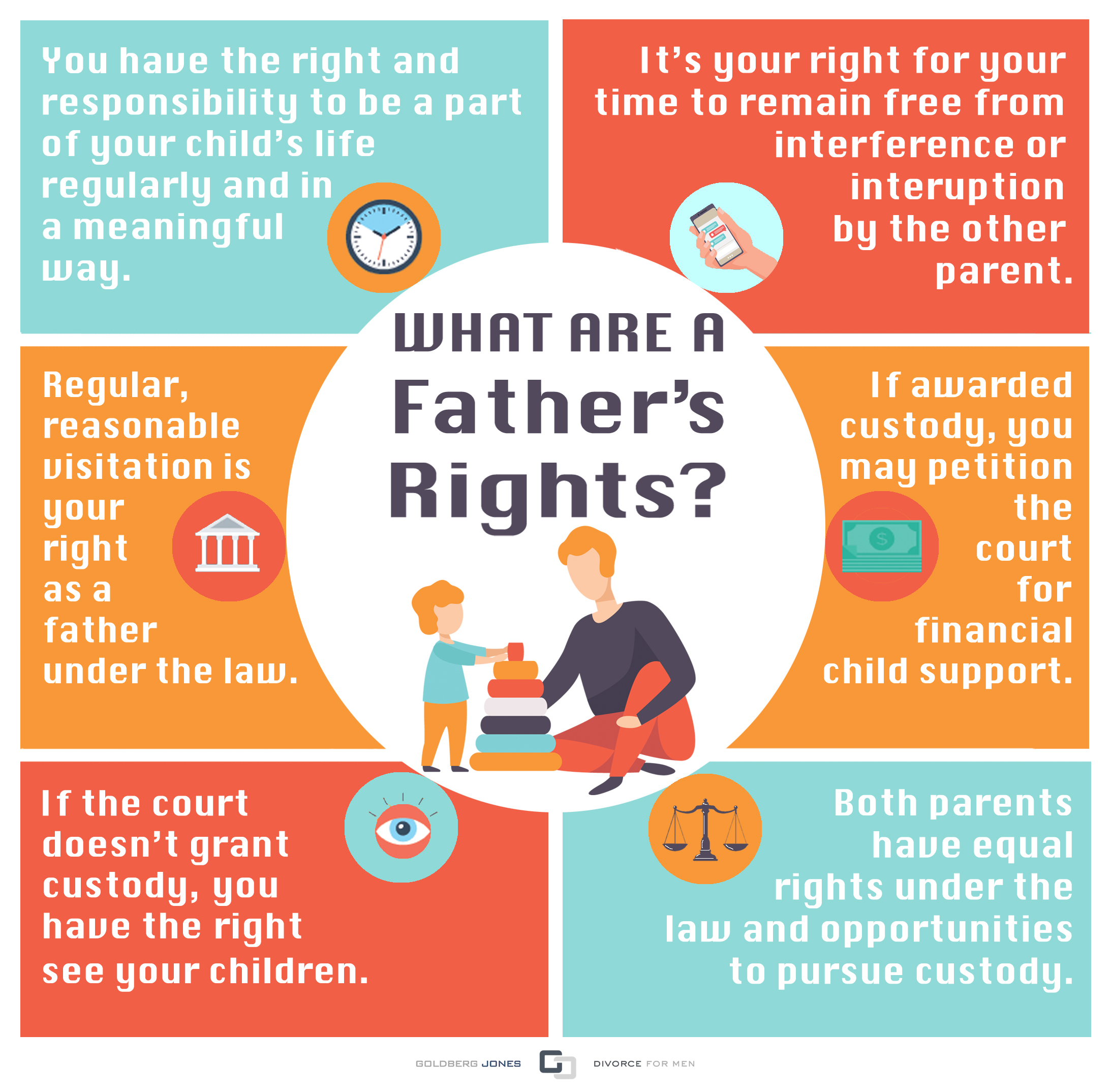
    • Barring extreme circumstances, you have the right and responsibility to be a part of your child’s life on a regular basis and in a meaningful way. Basically, should you and your spouse divorce, if it involves children, both parties have equal opportunity to remain fixtures in their lives.
    • Just like a mother, a father has the right to request primary guardianship.
    • If he does receive custody, he also has the right to petition the court for appropriate child support from his former spouse. This may be used to help provide for expenses like food, clothing, shelter, and other necessities.
    • If the courts don’t grant the father custody, he still has the right to see his children. This visitation will be reasonable and regular. In this scenario, you are also entitled to spend time with your kids free from interference by the custodial parent.

    Related Reading: Best Interest Of The Child

    How To Ensure Your Rights As A Father

    fathers' rights infographic
    (Opens in New Window)

    In recent years, there has been an increased emphasis, publicly and in the courts, on making sure that both parents play an integral part in a child’s life after divorce or separation. It’s important that you remain involved in the upbringing of your kids. However, you may have to take steps to ensure this happens.

    As already stated, you are equally entitled to custody during the divorce process. If you actively want primary custody, you have every right to pursue this goal.

    You may need to prepare and file a petition for custody, provide information about the parents and child, and ultimately wait for the court to decide on your request. Oregon law also requires that all such petitions include a parenting plan.

    When awarding custody, the court aims to serve the best interests of the child. To establish this, the judge examines a number of factors. This may include:

    • Your abilities as a parent.
    • Pre-existing relationships with your kids.
    • Stability.
    • Physical and emotional health.
    • Safety.

    If kids are old enough to have a preference, the court may take their testimony into account. However, if their wishes oppose their best interests, the court can ignore them.

    In short, don’t be passive. If you want custody of your children or significant visitation rights, take an active approach.

    It’s likely in your best interest to hire an attorney with experience working child custody cases. A lawyer will have insight into the process, as well as advice, both legal and practical, to lead to an optimal outcome for your case.

    Related Reading: Enforcement Proceedings: How to Protect Custody Rights

    The Rights Of Unmarried Fathers

    In some cases, it may be trickier to assert your rights as a father. For instance, if you and your child’s mother never married. In Oregon, however, unmarried parents have the same rights as their legally bound counterparts.

    If your paternity is established, and your name appears on the child’s birth certificate, you will be recognized as the legal father.

    As such, just like if you were married, you and the mother have equal legal standing in the eyes of the law. You have just as much right to pursue primary child custody as your ex, regardless of marital status. Should you be awarded guardianship of your kids, you also have the right to petition for child support.

    Similar to divorced or divorcing couples, the court considers factors like:

    • Income.
    • Ability to pay.
    • Custody schedule.
    • Need.

    These all figure into the amount. Even if you do not win custody, you will most likely still be entitled to regular visitation. The court will also likely order you to provide child support.

    Related Reading: Establishing Paternity In Oregon

    Ways To Help Your Custody Case

    You need to convince the court you’re best suited to be the primary custodian. It’s important to demonstrate your parenting ability and showcase what you bring to the table. With that in mind, here are some ways you can help your own child custody case.

    Work With Your Ex

    Like it or not, when you have kids, you’re going to have some contact with your ex.

    Unless the health or well-being of your children is in danger, you’ll have to work together as co-parents on some level. You may not like it, but bite the bullet and collaborate with your ex.

    Not only is it beneficial to the kids to have both parents involved in their lives, but this willingness to cooperate also helps your child custody case.

    Related ReadingParental Evaluations In Oregon

    Stay Part of Your Child’s Life

    It’s also vital to remain a part of your child’s daily life for a number of reasons. This strengthens the parent/child bond, it’s good for both of you, and it can help your case.

    Spending time with your children on a regular basis shows you are and want to stay an involved parent.

    Courts also try to avoid drastically shaking up a child’s routine when ruling on custody. When you’re already a big part of their life, it’s more likely to stay that way.

    Related Reading: Unmarried Parents’ Custody Rights

    Make Use Of Your Parental Rights

    We see it all the time. People claim to want custody but don’t take advantage of it when they have the chance. While a case is in progress, the court often issues temporary custody orders. These grant regular visitation and the like.

    Take advantage of time and opportunities the court gives you.

    This includes big, fun special events, but also regular things, like helping with homework and going to doctor’s appointments.

    It’s important for the kids that you’re present, but it also demonstrates you’re an involved parent who wants to be there for your children.

    Document Everything

    Two words can come in very handy in these situations: document everything.

    If your ex sends you an email denying you a scheduled visit for flimsy reasons, save it. The same goes for voicemails, instant messages, texts, social media posts, and any other form of communication.

    If you have concerns about your child’s safety in your ex’s care, document your reasons.

    Keep a record of the time you spend with your kids. That way, if your ex claims you’re not an involved parent, you can prove otherwise.

    Basically, whatever statements you make to the court about your ability as a parent, or your ex’s, collect as much solid evidence as you can to support your claims.

    Related Reading: Common Child Support Questions

    Don’t Interfere With Visitation

    By this point, there’s likely ill will between you and your ex. Divorce tends to leave scars. But it’s important not to use custody situations for revenge.

    If your ex has visitation scheduled, don’t interfere with it or stop it from happening.

    First off, recognize that it benefits your kids to have both parents in their lives. Meddling makes you look petty, but it also has a wider impact.

    If you complain about your ex hampering your own visitation, you can bet a judge will remember this you interfering with theirs. Acting like a rational adult only helps your custody case.

    Don’t Trash Talk Your Ex

    Again, you probably aren’t too fond of your ex right now. No one expects you to be best friends, but keep those feelings to yourself, especially around your children.

    Be there for your kids and serve their best interests. Don’t use them as pawns in your custody dispute or try to turn them against your ex. Not only it is unhealthy for them, but if you try to manipulate them, it can damage your cause.

    Focus on making yourself look good instead of making your ex look bad, you’ll get far more mileage out of that approach.

    Related Reading: Do Criminal Charges Impact Child Custody Cases?

    Hire A Child Custody Lawyer

    Child custody disputes often become heated. Tempers flare and people react emotionally instead of thinking things through. There are also tons of details and complicated laws that play into custody decisions.

    Because of all of this, it’s usually in your best interest to hire a child custody attorney, especially if your ex hired one. A knowledgeable professional helps keep things calm and guides you through the process.

    Related Reading: Enforcement Proceedings If Your Ex Won’t Follow The Parenting Plan

  • Mistakes Men Make In Divorce

    Over the course of the process of ending a marriage, things tend to get messy and complicated. There are a number of common mistakes made in divorce. Mistakes that damage your own case.

    In straightforward, low-conflict cases, things may progress smoothly. However, with forms to fill out, appointments to appear at, and many other moving parts, it doesn’t take much for problems to arise. That doesn’t even take flaring emotions into account.

    Mistakes Men Make in Divorce

    Men often make mistakes in divorce in a number of areas. It’s vital to know these common missteps and steer clear of easily avoidable problems.

    Ill-advised choices harm your cause in a variety of ways. You may miss out on assets in the division of property. Mistakes can impact spousal maintenance, child support, or even custody arrangements.

    What Not To Do

    Don’t Ignore Finances

    This should come as no surprise, but divorce is expensive. One of the frequent mistakes men make in divorce is ignoring finances. It costs money to file papers or respond to a motion. Then there are attorney’s fees.

    When preparing for divorce, put money aside so unexpected expenses don’t blindside you.

    Beyond that, you also have many other factors to consider, including:

      • Keep an eye on joint bank accounts or credit cards.
      • Make moves to establish your own individual accounts.
      • If you’re on your spouse’s health insurance, you need to find your own coverage.
      • Document all of your assets and debts.
      • Don’t forget about your financial paperwork. This includes bank statements, retirement papers, loan documents, life insurance policies, investments, and other similar documents.

    You have to submit this to the court anyway, so having it ready in advance saves time.

    It also gives you a clear picture of what you have. Too often, men think they have a handle on what they make and spend, only to have that come back and bite them.

    Related Reading: How Do Major Purchases Affect Divorce?


    Don’t Settle On Unfavorable Terms

    Even in the best of times, divorce is stressful and emotional. By the time you reach this point, you probably just want it to be over and done with as fast as possible.

    That’s a natural feeling. But it also leads people to damage their own divorce cases and is a common mistake men make in divorce.

    Too frequently, people agree to unfavorable terms in a settlement simply to get to the end. Dissolving a marriage hurts and the process takes a long time, but don’t settle just to speed things up. Take the time to consider what you truly want and go after it.

    Finances, child custody, spousal support, and more have huge impacts on your future. It’s important to take the time and get what you need from divorce.

    Related ReadingHow Long Does Divorce Take?


    Don’t Move Out Too Soon

    If your marriage is broken beyond hope of repair, it makes logical sense to move out of a shared home. However, while moving out seems like a natural choice, it can have serious long-term consequences you need to be aware of.

    In terms of custody, moving out may create the perception, true or not, that you’re abandoning your kids or that you’re not a dedicated parent. Children pick up on tensions at home and no children want to watch their parents fight.

    The urge to escape this conflict or alleviate the tension is natural, but it can also hurt your chances of getting custody down the road. The courts want to limit changes in a child’s life, so if you establish a precedent that you’re okay with minimal parenting time, that can come back on you.

    In terms of property division, moving out of a shared home can diminish your claim to it later. A house is likely the most valuable thing you own. Because of this, it’s also the most substantial piece on the table when it comes to splitting up assets.

    In regards to spousal support, when you move out, the bills still stay behind. Even after setting up a new residence for yourself, the court may presume that the amount you pay in both residences is financially viable and order you to continue to pay that amount, or something similar.

    Related Reading: Moving Out Too Soon, How Does it Negatively Affect Your Divorce?


    Don’t Be Passive

    Don’t be too passive in the divorce process.

    You may want to get this over and done as quickly as possible. It’s easy to agree to everything your spouse proposes and move on. After all, it cuts down the conflict and speeds things up.

    But that can harm your best interests and cause serious long-term financial consequences.

    The division of property, spousal support, and child custody all greatly impact the next step. Take the time to figure out what you want and fight for it when necessary.


    Don’t Argue About Every Asset

    The flip side of that coin is arguing about everything. This is one of the big mistakes men make in divorce.

    You may not want your ex to get anything and fight every step of the way. After years of marriage, you’re bound to have legitimate disputes.

    But some people fight out of spite or revenge. This gets expensive, wastes everybody’s time, and leads to more conflict and trouble than necessary.

    In general, the court divides property in an equitable fashion anyway. It may skew one way or another, but overall, the scales rarely tip severely to one side.

    Also, fighting about every individual item gets exhausting. You have way more important things to spend your energy on. Again, think about what you truly want and truly need. Pick your battles where they’re most important.

    Related ReadingWhat is Legal Separation and Is it Right for You?


    Don’t File For Divorce When You Aren’t Prepared

    Many think that being first out of the gates gives you an advantage and rush to file for divorce first. This does prove true in some cases, but not all. Depending on the situation, this strategy can cause people to seriously damage their own divorce cases.

    If you’ve prepared ahead of time, have everything in order, and feel ready, by all means, file the paperwork and start the divorce process. But too often, people don’t adequately prepare first.

    Organize your documents, set money aside, and have a clear plan of action. Establishing a solid foundation for your case benefits you far more than being the first to file. In the end, both sides have the opportunity to present their cases, and most of the time, any advantage to filing first is relatively minimal. Being prepared and organized has much more of an impact.

    Related ReadingDivorce And Filing Forms: How To Get Divorced In Oregon


    Not Consulting An Attorney

    It’s easier than ever to take a do-it-yourself approach to end your marriage. Online resources offer a step-by-step guide through the process. Just download the forms and with a minimum of fuss, you can file, pay the fees, and be on your way.

    While it’s ideal for certain situations, this DIY approach often leads people to damage their own divorce cases.

    This strategy works best in simple situations. Usually, this means shorter marriages without children and with little or no shared property. DIY often works well in these scenarios.

    But the longer a marriage, the more complicated the case, and the more complex the process will become. The potential to make mistakes increases, and it’s possible to do a great deal of harm without speaking with an attorney.

    One of the common mistakes men make in divorce is thinking they don’t need help. It puts you at an even greater disadvantage if your spouse has an attorney and you don’t.

    Related Reading: What is Pro Se Divorce? A Look At DIY


    Don’t Ignore Self-Care or Mental-Wellness

    Mental health is a prominent casualty of divorce. Men are more likely to suffer from depression in the aftermath. This despair often leads to a downward spiral—sometimes gradual, sometimes rapid.

    Dont Keep It To Yourself and Bottling It Up

    Often arriving with a potent cocktail of guilt, anxiety, uncertainty, grief, and even fear, divorce can be a sucker-punch to self-worth and self-esteem.

    Programmed to suffer in silence, many men carry this heavy weight on their shoulders alone rather than turning to friends, family, loved ones, or even professionals to help cope with these feelings.

    This frequently becomes a negative influence on overall mental and emotional health.

      • Men are more likely to suffer from depression following divorce.
      • Alcohol abuse, drug use, and other potentially detrimental behaviors spike in the wake of divorce as many men look to otherwise occupy themselves.
      • Following a divorce, suicide rates in men swell.
      • Men have been shown to be at an increased risk for a variety of health issues after divorce. This includes hypertension, heart disease, and even cancer, among other serious concerns.

    You don’t need to post every thought you have on Facebook—in fact, maybe stay off social media during the divorce—but it’s nice to have people to confide in. You may even want to look into seeing a therapist. Professionals offer helpful insight and advice in trying times.


    Your Lawyer Can’t Be Your Therapist

    Divorce lawyers are privy to intimate details about your life. Often things no one else knows, not even close friends. Too often this leads people to unburden themselves. This costs time and, importantly in this case, money.

    Your lawyer wants the best outcome for you and should empathize with your situation. But they’re not your confidant. Their job is not to offer emotional support and help you deal with personal problems.

    Talking to a therapist, counselor, or support group is beneficial and healthy. It’s often a key part of dealing with the complex emotions of divorce, recovering, and moving on.

    Also, a mental health professional has more tools and resources to help you through an emotional, turbulent time. They’re better equipped to help with what you’re going through. And likely less expensive.


    Don’t Act Out Of Spite

    Divorce often comes with wounded feelings, anger, and disappointment, all of which may well be justified. But acting out of spite and using this as a tool to get revenge is one way people damage their own divorce cases.

    More often than not, this makes the situation messier than it needs to be.

    It creates hostility, conflict, and additional problems. People often waste time and energy, and money, fighting about things that are in reality relatively minor.

    Divorce is a complex process with many roadblocks and problems that pop up. This list represents just a few common mistakes men make in divorce. Much of your future hinges on decisions you make here and now, so it’s vital to spend the time and effort to get it right.

    Related ReadingDo You Qualify For A Summary Dissolution?


    From Goldberg Jones Radio
  • Status Quo Orders In Divorce and Child Custody

    During divorce and breakups, child custody battles often become heated and contentious affairs. In some situations in Oregon, the court issues temporary orders lasting the duration of a case. This may include temporary custody arrangements or even implement temporary child support.

    Some divorces and separations start with one parent taking the kids from the other, pulling them out of school, hiding them, and the like. If you’re trying to keep a child’s living situation and routine in place, a status quo order may be in order.

    A status quo order can serve almost as an effective, inexpensive, “light duty” custody order.

    What Is A Status Quo Order?

    A Latin term, status quo, means “the existing state of affairs, the way things are.”

    In a legal setting, judges use a status quo order—also called a temporary protective order of custody and restraint—to maintain a situation. This prevents parties involved from affecting change until the matter at hand is resolved.

    When it comes to family law cases, like divorce and child custody matters, these manifest in a number of ways. Once in place, until further judgment arrives, they preserve the living arrangement, parenting time, and maintenance support.

    These orders are designed to protect minor children during the legal process. In custody situations, the child’s health, safety, and well-being take precedence over other concerns.

    A status quo order may prevent one parent from taking the child from a home or area without the other’s consent.

    Once issued, this decree stays in place until the parents agree on a parenting plan or the court issues custody orders.

    Related Reading: Writ of Assistance, Custody, and Divorce

    How This Applies to Family Law

    Oregon courts have the power to issue a status quo order at the outset of the legal process.

    In a practical sense, they prevent each parent from doing six specific things:

    • Changing the child’s usual place of residence;
    • Interfering with the child’s present placement and daily schedule;
    • Hiding or secreting the child from the other party;
    • Interfering with the other party’s usual contact and parenting time with the child;
    • Leaving the state with the child without the written permission of the other party or the court;
    • Or in any manner disturbing the child’s current schedule and daily routine until custody or parenting time has been determined.

             Related Reading: Child Custody in Oregon

    Objecting To A Status Quo Order

    A status quo order takes into account parenting time, custody, and school location for the three months prior to the request. But what if you object to the status quo as laid out in the status quo order?

    For example, your ex serves you with a status quo order saying she doesn’t want to upset your daughter’s routine and that she has custody five days a week, but that’s never been the case.

    Fortunately, you can raise objections to how the status quo is portrayed.

    As with most legal matters, you must prove your claims. You need to provide your own version to help solidify your assertion in this area. Document as much evidence as you can and have reliable witnesses you can call to back up your side of the story.

    Related Reading: Parental Evaluations In Oregon

    Immediacy Of the Order

    One of the big benefits of a status quo order is the immediacy.

    You or any party served with a status quo order has the right to request a hearing. In Oregon, the courts must make a reasonable effort to schedule the hearing within 14 days. At the outside, a hearing must take place no later than 21 days after the court receives the request.

    While this doesn’t award custody, it does cut the legs out of a bad actor. You go to court almost immediately. Without a status quo order, you often have to wait 30 to 60 days, or longer depending on the county, for a temporary order hearing.

    Like temporary protection measures, the intent of a status quo order is to further a child’s best interests. This can be to protect them from potential harm, as in situations of abuse or neglect, or to ensure stability during a tumultuous time.

    As with most legal matters, there are many boxes to check off and things can get complicated in a hurry. Whichever side you fall on, you must substantiate your position and provide proof of your claims.

    Improper use of such orders can have an impact down the road. It may influence the final decision from the court, impact the ultimate parenting plan, or you may even have to pay your ex’s attorney fees.

    Related Reading: Child Custody Enforcement Proceedings

  • 5 Common Ways To Celebrate Divorce

    People love to celebrate. We’ll take any excuse to throw a party, whether it’s a holiday, a promotion at work, or the Trailblazers making a playoff run. While we usually think of ending a marriage as a serious, somber affair, that’s not always the case. Increasingly, many people take the occasion as an excuse to celebrate divorce.

    It’s difficult to end a marriage and it alters your life in almost every way. Even when it’s the right decision, the absolute best choice, that doesn’t make it any easier. There’s so much stress and emotion involved that when it’s finally over, it’s normal to feel an intense sense of relief and even freedom.

    It’s easy to wallow, but more and more, people choose to celebrate divorce instead. And what better time to party than when you close the door on a painful chapter of your life and start off in a new direction?

    Commemorating the dissolution of marriage takes many forms. One company sells tiny coffins to bury your wedding ring, and people often burn mementos from their relationship in a cathartic act. But let’s take a look at some of the more festive, life-affirming, and downright fun ways people celebrate divorce.

    Ways to Celebrate Divorce:

    Divorce Parties

    What better way to celebrate divorce than by throwing a party? This is also probably the most obvious, high-profile ritual for moving forward. Who doesn’t want to be surrounded by loved ones and have a good time after a trying experience?

    Divorce parties take many forms and cut across the whole spectrum. Maybe your ideal way to celebrate divorce is to share a quiet meal, a few drinks, and some laughs with close friends. Then again, after ending your marriage, maybe you’re in the mood for an all-out rager the cops have to bust up.

    How you celebrate divorce boils down to personal preference. But this type of revelry has become so commonplace that party planners and event specialists regularly field such requests. From subdued to outrageous, no matter your tastes, there’s someone out there to help you plan the perfect divorce party.

    Related Reading: Surviving Thanksgiving For Divorced Dads

    Divorce Cakes

    What’s a party without a cake? And what’s a divorce party without a divorce cake? A wedding cake is an integral, symbolic part of most marriage ceremonies, so it adds a bit of poetic justice to have one at the other end.

    A veritable cottage industry has sprung up around divorce cakes. Just do a quick Google image search to see the incredible variety that exists in the world.

    These divorce desserts run the gamut from simple sheet cakes with words like “Freedom” written in frosting to elaborate, multi-tiered confectionary wizardry.

    Think broken hearts, a chocolate ball and chain, and effigies of exes being devoured by monsters. Astonishing inventiveness abounds, and there’s a certain catharsis to literally biting off your ex’s head, even if it’s only in tasty dessert form.

    Related Reading: How Oregon Divides Property in Divorce

    Divorce Selfies

    Selfies are a ubiquitous presence these days, so the rise of divorce selfies probably shouldn’t surprise anyone. Couples amicably ending a marriage have started taking to social media to joyously celebrate divorce and share their enthusiasm with the world.

    Often these photos take the form of a smiling, otherwise happy-looking couple. They brandish divorce certificates or show off a newly ring-free finger on their left hand. Some are simple, straightforward, and spur-of-the-moment, while others are more elaborate and planned out in advance.

    Ending a marriage doesn’t always have to be dour and rife with conflict, and divorce selfies illustrate this. Not every split turns into a contentious, knock-down-drag-out fight between spouses. And marriages don’t always end on bad terms. Maybe your union just didn’t work or the two of you simply grew in different directions.

    It’s possible to divorce and move forward with positivity, to see divorce as a good thing, and that’s worth celebrating.

    And even if their divorce was a hellacious affair, many still take to social media to mark the occasion. After all, pics or it didn’t happen, right?

    Related Reading: Ways to Prepare for Divorce

    Do Something You Always Wanted To Do

    Divorce often comes with a newfound feeling of freedom and liberation, like casting off an anchor that held you down. One way many people celebrate divorce and this fresh independence is to do something they’ve always wanted to do but haven’t been able to do before.

    How this urge manifests is as different as the individual people out there. Maybe you’ve always wanted to travel abroad, go on a cross-country road trip, or live in a new city. Perhaps it’s time to challenge yourself and train for that marathon you’ve dreamed of running. Have you always wanted a tattoo but your ex hated body art?

    Newly unfettered by the bonds of marriage, one way to celebrate divorce is to indulge these whims.

    Related Reading: Breaking Down Divorce Rates by Generation

    Reinvent Yourself

    Along the same lines, starting over means that you have the opportunity to start fresh and reinvent yourself. You can revamp your personal style, update your wardrobe, or get in shape. Now you have the freedom to release your dormant passions, experiment with new ones, and become the best version of yourself.

    People have come up with all manner of ways to celebrate divorce. From gift cards and bumper stickers to massive parties and completely retooling their lives, endless possibilities await.

    People react to ending a marriage in a variety of fashions. But it’s probably best to celebrate divorce in a positive way, to revel rather than mourn. Especially if you have children, it’s important to keep things amicable. You’ll have to deal with your ex on a continual basis, and rubbing their nose in it will likely lead to bad feelings and friction.

    Related Reading: 9 Common Mediation Questions Answered

  • Divorce Over Politics? How Political Differences Cause Divorce

    The old maxim goes: never talk politics or religion in polite company.

    It’s taken numerous forms over the years, but that’s the general gist. And it’s solid advice. People feel passionate about these topics and conversations often become heated. Friendships have ended for less.

    It’s one thing if coworkers or even friends have drastically different political beliefs. This often leads to difficult interactions in social situations or at your job. That’s hard enough to handle. But it’s something else when it’s your spouse.

    In reality, politics and political leanings often have a huge impact on the stability of relationships and marriages. Ongoing political disagreements often lead to divorce. And it’s only getting worse.

    With divisive political figures, most notably Donald Trump, amongst others, and contentious issues cropping up on a regular basis, it’s increasingly common to see cases where politics cause divorce.

    Related Reading: Has The Divorce Rate Ever Been 50%? Nope.

    The Trump Effect

    Popularized as “The Trump Effect,” the 45th President of the United States had a significant impact on divorce and relationships. He mobilized a wave of supporters, exploited key differences, and created a significant rift in many circumstances.

    His presence in the Oval Office also had a substantial impact on personal relationships. Friendships ended, families were at odds, and marriages came to an end, all because of individual feelings toward the former POTUS. A trend that has continued.

    One of the most highly publicized examples is the case of Gayle McCormick. The 73-year-old retired California prison guard divorced her husband of 22 years because he voted for Trump. She called it a “deal-breaker” and said she felt “betrayed.”

    Related Reading: Saving Money on Divorce

    Generational Differences and Politics

    While McCormick’s case may be the most well-known, she’s nowhere near the only one to react this way. In December 2016, a poll of 6000 people found that 16% of those who responded stopped talking to a friend or family member as a direct result of the election. 17% also said they blocked friends or family on social media for the same reasons.

    Wakefield Research, a marketing firm, also conducted a similar survey. Their in-depth study of 1000 “nationally representative U.S. adults” found comparable results.

    Their collected data indicates that 11% of Americans, more than one in ten, have ended relationships over political differences.

    For younger generations, this number climbs steeply.

    • According to the responses, 22% of Millennials, more than one-fifth, have ended a romantic relationship because of political strife.
    • 22% of people in the Wakefield survey know someone “whose marriage or relationship has been negatively impacted specifically due to President Trump’s election.”
    • This number skyrockets for younger people, spiking to 35% for Millennials.

    Related Reading: Breaking Down Divorce Rates By Generation

    Political Differences and Divorce

    Politics and divorce often go hand in hand. Such disputes have always been a huge source of shattered marriages. That’s unlikely to change anytime soon. But what can you do if you and your spouse fall on opposite ends of the political spectrum?

    Such conflict can kill relationships and lead to divorce. Can is the keyword.

    Just because such differences often cause conflict that ends marriages, that doesn’t mean they will. It’s not inevitable.

    Every situation involves different people and no two play out exactly the same. If you and your spouse have political disagreements, whether that leads to divorce depends on you.

    Some couples are able to work around opposing views. It may take time and effort, or even steps like counseling, but it may be possible. One approach is to focus on the values you share instead of those you don’t.

    People from all walks of life, backgrounds, and political parties marry and lead happy lives. It happens all the time. But even if a couple finds a temporary solution, that may not be the best base for a successful marriage.

    Related Reading: Creating a Divorce Strategy

    Ignorance is not Bliss

    Pretending a disagreement doesn’t exist isn’t a great strategy. Ignoring a problem doesn’t make it go away.

    It may work in the short term, but it can lurk under the surface and cause unseen, unacknowledged tension. In the end, burying it may only lead to a bigger fight down the road.

    At some point, if you can’t find a way to comfortably live together, you may need to reexamine your marriage.

    Some differences are simply too profound, too fundamental to get past. No matter how much you care about one another, you may need to take a long, hard look at your situation and give it an honest evaluation.

    Can you continue to live with and love a person you disagree with on a basic, deep-down level?

    Only you can answer that question for yourself, but it’s one you need to figure out eventually. At some point, the detriments start to outweigh the benefits and it’s important to determine what you need and what’s in your best interest.

    Related Reading: Divorce Statistics: Interesting & Surprising

  • How COVID-19 Affects Divorce, Support Payments, and Child Custody

    SKIP AHEAD:
    How Does COVID-19 Affect Divorce?
    Are Courts Still Open?
    Can You File For Divorce?
    What Changes Are There in the Divorce Process?
    Are Parenting Plans Still Enforceable?
    What If You’re Behind On Support Payments?
    If You Lose Your Job Due To COVID Can You Get A Support Modification?

    Over the past two years, COVID-19 has impacted nearly every facet of our lives. This includes divorce, custody situations, and other family law matters.

    First, we want to reassure everyone that we remain open for any issues you face. We’ve been here and we will continue to be here to help.

    We’ve implemented methods of remote communication when necessary or you prefer. Because our office has long been looked at as a national resource for clients that live out of state, we are also well ahead of the curve in remote communication methods. We also keep a rigorous cleaning regimen to ensure everyone’s safety.

    HOW DOES COVID-19 AFFECT DIVORCE?

    Frequently Asked Questions

    This is a strange time for everyone, but we’re still here to do what we can to guide you through as best we can. We have received many questions from clientele that we want to share in the form of an FAQ below:

    Are Courts Still Open?

    Despite changes and new hurdles to clear, the courts remain in service during COVID-19.Courts have been closed, run at reduced capacity, and dealt with a significant backlog. But they are open.

    This puts more attention on alternative methods of dispute resolution such as mediation and arbitration. These are tools that have already been very effective in resolving cases short of trial and are especially valuable now.

    Can You File For Divorce?

    Yes, you can proceed with a divorce, settling custody disputes, modifications, and other cases. It may look different, but with tools like video conferencing and other remote communication technology, you can still accomplish your goals. In reality, finalizing your may also take longer as well.

    What Changes Are There In Divorce Process?

    One of the biggest roadblocks currently is resolving temporary orders. An overloaded court system is dealing with a glut of cases, which has caused delays in this area. It also affects trials, though there are ways to resolve your divorce without appearing in court.

    Again, this only serves to highlight the benefit of alternative dispute resolution tools like mediation and binding arbitration. These methods are already proven to be less costly and more efficient ways of resolving case issues.

    Are Parenting Plans Enforcable?

    The short answer is that there is no change to the enforceability of your current parenting plan or custody order.

    However, there will definitely be issues and strains to contend with. Thanks to COIVD-19, variants, and spikes in cases, things remain in a state of constant flux. School, travel, and more get caught up in this uncertainty.  We’ve seen unusual issues arise during this time and deal with them best we can.

    Ultimately, now is a time for both parents to try to work together in addressing the best interests of their children. Fortunately, there are many ways to communicate and connect digitally. Just make sure you don’t overstep any bounds in the parenting plan. It’s still important to play by the rules and avoid any unnecessary tension between you and the other parent.

    This gives your kids, and you, something to look forward to. Regular chats also build a routine and help establish a sense of normalcy that often alleviates anxiety. Everyone needs that right now, especially your kids.

    Sticking to the parenting arrangement, even virtually, also benefits any future custody cases. Taking advantage of your scheduled time with the kids demonstrates your desire to remain an involved parent. That reflects well on any claim you make down the road.

    Most of all, it’s important to keep the lines of communication as open as possible.

    What If You’re Behind On Support Payments?

    In the United States, if you’re behind on your child support payments, the Division of Child Support must, by law, certify past due child support debts to the Federal Office of Child Support Enforcement for enforcement.

    Even when behind on payments, if COVID-19 caused the delay in payment, you still have the right to argue for modification. Again, you have to show the impact. Demonstrate how the pandemic led to unforeseen and continuing financial devastation. This may serve as evidence to support your claims.

    If You Lose Your Job Can You Get A Support Modification?

    The easy answer is that your current support order is enforceable. Unlss you file for modification or adjustment, which you would need to initiate.

    The good news is that a significant drop in your finances due to COVID may show the need to modify an existing support agreement. The bad news is that you face an uphill battle.

    If both parties are on good terms, you can try to settle outside of court. If that isn’t an option, the next step is to file a motion to modify the support order with the local court.

    What Type Of Evidence Is Required?

    Timing is important. COVID-19 remains an open-ended battle. Though things keep moving in the right direction, there’s no saying how much longer we will feel its impact.

    Presenting evidence makes a big difference. When looking to modify a child support or spousal maintenance order, you have to show your work.

    Loss of employment or income due to COVID-19 is the starting point. Document everything, right away. This helps build a stronger case to present to the court. A judge will want to see that this was unintentional and out of your control.

    Additionally, take steps to alleviate the loss of income. Seek out other jobs or take advantage of unemployment benefits or emergency relief. Again, track all of your efforts. This demonstrates a good faith effort to find new income.

    Review Your existing support order

    It’s always a good idea to take a close look at your existing support order. Many divorcing couples settle support obligations outside of court and maintain them by a separation agreement rather than a court order.

    These agreements often contain a material change clause.

    A material change clause allows you to review payments in the event of a change in circumstances. It may include a protocol for modification requests for situations like the loss of a job. In general, it’s a good idea to be well acquainted with these documents.

    This article will be updated as more information becomes available.

    Related ReadingChild Custody Modifications

  • Oregon Pet Laws, Pet Custody, And Divorce

    Many of us who own pets know they’re much more than just property. They may be valued members of our family and, in some cases, even surrogate children. The law, however, often views them as possessions and treats them as such in divorce. That is changing, however.

    There is often a discrepancy between how animal lovers view their pets and how the law looks at them.

    In a legal sense, the law considers pets like dogs, cats, horses, and all the rest, property. In this regard, they’re no different than a car, couch, or other possession.

    legal value of petsThough pet owners ascribe them a much greater worth and importance, companion animals have a monetary value. In many divorce cases, the courts assign a dollar amount to animalsand treat them similarly to any other piece of property.

    Ideas around pet custody have changed somewhat, and though it’s a gradual process, courts have recognized the significance of companion animals beyond a simple dollar amount.

    In some cases, settlements account for the emotional loss pet owners experience. A handful of states have passed legislation that can award substantial monetary settlements for the loss of affection and friendship of pets. Continuously evolving, this is an interesting area to watch develop.

    Related Reading: Is Oregon a Community Property State?

    Property Or Family Member?

    A recent case the State Supreme Court ruled on may impact how Oregon pet laws regard our animal companions moving forward. This could bleed over into divorce and pet custody battles.

    The case at hand involves a Portland-area dog owner found guilty of starving and neglecting her animal. A veterinarian collected evidence for the case, drawing blood from the dog. The issue is that the vet acquired this evidence without a warrant.

    Oregon’s high court ruled that dogs are not “mere” property, like a suitcase or other container. As such, they don’t require a warrant to examine internally.

    In broad terms, this decision makes it easier to pursue criminal charges against animal abusers. It also represents a changing tide when it comes to how the law views animals.

    How This May Impact Divorce Settlements

    Custody battles involving children are often hotly contested cases. Increasingly in recent years, so are fights over who gets pets in a divorce.

    While there are numerous legal precedents when it comes to determining where the kids end up, as far as pets go, even though these situations often involve similar emotions, the path is not as clear.

    Traditionally, courts generally treat companion animals as property. On paper, they have the same status as an end table, lamp, or another asset to be divided in a divorce settlement.


    Animals continue to play vital roles in many of our lives, and battles over pet custody are now commonplace. This isn’t going to change anytime soon, and as we continue to attribute significance to their presence, our pets’ legal status changes by degrees. With this latest case, it may be another step in that direction.

    Determining Pet Custody

    Despite the emotional value we give our pets, Oregon pet laws classify them as property. Courts can distribute them as such when it comes to cases of divorce and separation.

    This varies a great deal from judge to judge and court to court. You can never be fully certain how things will go in a particular case. Some judges are sympathetic while others may view arguing over who gets the cat as a waste of time.

    When it comes to determining who gets pet custody in a divorce, a number of things come into play.

    • Who acquired the pet in the first place can be a determining factor.
    • If there is a purchase agreement or adoption certificate in the case of rescue animals, the court may take that into account.
    • If you obtained your dog before your marriage, that will likely factor in.
    • Things get tangled, however, as many couples, married or otherwise, adopt or purchase pets together.

    Who fills the role of the primary caregiver may also factor into pet custody.If one spouse tends to the day-to-day needs of an animal, that can come into play.

    If you feed the cat, walk the dog, take them to the vet, buy their food, make sure they’re properly licensed and micro-chipped, and see to all of those necessities, it may figure into guardianship. As before, things become hazy if both spouses equally participate in this regard.

    It’s even possible that the court, like with custody cases involving actual children, may take the animal’s best interests into account. If it’s clear that one spouse or the other is the better provider or the animal’s health and well-being may be in question, they may award custody on that basis.

    Ways To Protect Pet Custody

    As much importance as we give many of our companion animals, the topic of pet custody may figure prominently in your divorce. With their legal standing falling in such shadowy territory, you may want to take steps to protect your interests.

    Entering into a premarital agreement is one way to make sure you retain custody of your pets. This is easier when it involves pre-existing ownership. But you can create a treaty that specifies where the animals end up.

    Even if you and your spouse acquire an animal together, you can set up a custody plan ahead of time. That way, if your relationship crumbles around you, Oregon pet laws aren’t a concern, and your animals are taken care of. These types of arrangements may not always be 100% legally binding. However, the court may take them into account during the division of property.

    Other Custody Options

    Other options to explore include arbitration or mediation.

    Some judges won’t want to hear this type of argument. So this route may provide the opportunity to more fully present your case to retain pet custody than in traditional divorce proceedings. You may be able to concede certain assets and come to an accord with your spouse.

    As with human children, shared custody with visitation rights is also a possibility.

    You and your soon-to-be-ex may be able to hash out an informal agreement. Again, this may not be legally enforceable, but if both parties are willing to play ball, this is an option.

    Related Reading: 9 Common Mediation Questions Answered

    In a legal sense, the area of pet custody doesn’t always reflect the current social standards. This is changing in a number of ways, illustrated by the mentioned case in Oregon. For the most part, however, Oregon pet laws designate Fido and Mr. Kitty property. Because of this, courts most often treat them that way in a divorce.

    Many attorneys have found creative ways to argue the relative value of companion animals in a legal arena. Though attitudes and laws continue to shift, it’s a gradual process.

    If you form close emotional connections with your pets, you may want to take steps to ensure they remain in your care in the case of divorce.

    Related Reading: 5 Tips for Keeping Custody Exchanges Civil
    Related Reading: Enforcement Proceedings: How to Protect Custody and Visitation Rights

  • Fighting Parental Alienation

    In the wake of a divorce, it’s not uncommon for parent-child relationships to take a hit. You may not see your child as often and you may not be a part of their day-to-day lives. This is tough, but it’s even worse in cases where parental alienation rears its ugly head.

    Parents who experience this face many challenges. It can be overwhelming and uncertain. This makes it difficult to maintain your relationship with your kids.

    But what is parental alienation and what can you do to cope?

    What is Parental Alienation?

    Parental alienation is:

    “[T]he process and the result of psychological manipulation of a child into showing unwarranted fear, disrespect or hostility towards a parent, relative, or others”

    Basically, it’s when one parent wages an intentional campaign, turning a child against the other. There are many signs, and, as the definition states, it can also focus on other people.

    It can even reach extended family members, though parents are the most common targets.

    How To Fight Parental Alienation?

    Parental alienation can irreparably damage your relationship with your child. It can also harm them in many other ways. That’s why it’s important to know how to push against it and fight back.

    Have a Plan

    One of the best ways to protect yourself is to create a detailed parenting plan. This outlines your rights and obligations and provides the framework for enforcing those rights.

    It’s imperative that this document includes significant visitation. The more present you are in the child’s life, the more difficult it is to turn them against you.

    Vague parenting plans invite opportunities for manipulation. If it doesn’t include specifics and details, your ex may be able to undermine how much time you spend with your child and do long-term damage to your bond.

    Related Reading: Child Custody: The Best Interests of the Child

    Good Rules Mean Nothing if Not Enforced

    While it’s important to have a detailed parenting plan, it only protects your rights if you enforce them. This document only helps if you use it.

    Many parents let little things slide to be amicable and accommodating. But all too often, these small transgressions add up and become big problems.

    This isn’t to say you need to run to your divorce lawyer every time your ex drops your child off half an hour late. That also adds up in a different way. But be wary of developing patterns and nip them in the bud. Don’t let your ex deny your court-ordered visitation. It’s much easier to deal with issues when they’re minor. Don’t let them become major.

    That said, simply complaining about violations of the parenting plan isn’t enough. You have to pay attention and take active steps to secure your parental rights.

    Related Reading: Enforcing a Parenting Plan

    Contempt can Lead to Custody Changes

    Enforcing your parenting plan with the court has several significant effects.

    First, it establishes your commitment to remain a consistent, involved part of your child’s life.

    Second, it creates an official record of parenting plan violations.

    A parenting plan is a court order. It’s a legally binding document. Violations, especially continued ones, can be construed as contempt. Multiple infractions carry consequences, including the court demanding changes to the original schedule.

    Family Counseling May Be Needed

    Sometimes you can do everything right and parental alienation still strikes. It can get to the point where even modifying the parenting plan isn’t enough.

    If you’ve become estranged from your child, you may have to take more drastic steps to repair the damage. Family counseling is one tool to use to combat this phenomenon.

    Parental alienation can be devastating. It can also be difficult to prove. So it’s best not to let it get to that point if it can be avoided.

    Take steps to remain an active part of your child’s life, keep an eye out for potentially damaging patterns, and, if necessary, consult a mental health professional or your divorce attorney and ask for help.

    Related Reading: Custody in Oregon: Parenting Evaluations