Category: Featured Content

  • How to Divorce in Oregon

    We often field questions about how to divorce in Oregon.

    Filing for divorce sounds like a harrowing, dramatic undertaking, and it usually gets complicated. Ending a marriage often becomes a long, intricate process.

    There are hearings, mediation, meetings with attorneys, arbitration, custody disputes, property division, and more. Then you have the divorce forms to contend with.

    How Do You Divorce In Oregon

    On a basic level, divorcing in Oregon isn’t nearly as complicated as many assume. It is a process to be sure, but the steps are relatively straightforward.

    Still, being as prepared as possible will only benefit your case. It never hurts to familiarize yourself with the stages before hand and know what lies ahead.

    With that in mind, here’s an overview of the process and a look at the divorce forms you may encounter.

    Fill Out The Divorce Forms

    Like with any process, there is a moment when it begins.

    In the case of divorce, that happens when one spouse completes and files the Petition for the Dissolution of Marriage. This is where the process truly begins.

    Five pages long, this form lays out all the pertinent facts about the case.

    Though the underlying reasons for ending your marriage are likely complicated, this first step is relatively simple.

    On this form, you provide all the pertinent information for you and your spouse. This includes:

    • Where you live.
    • The date of your marriage.
    • The length of your marriage.
    • Each party’s current living situation.

    You also answer other relevant questions. Depending on the situation, this includes information about:

    • Child custody/guardianship.
    • Child Support.
    • Spousal support.

    You must also disclose any shared assets and debts at this juncture.

    Related Reading9 Common Mediation Questions Answered

    Forms For Two Types Of Divorce

    In Oregon, there are two types of divorce. The appropriate type depends on the specifics and complexity of your case. This also impacts the forms you need to fill out and submit.

    Oregon is a no-fault divorce state, so there’s no need or space to assign blame for the end of the marriage. You don’t have to prove your ex was the problem, if you want to divorce, the state won’t stand in your way.

    SUMMARY DISSOLUTION

    Relatively simple, straightforward marriages often qualify for summary dissolution. This allows you to end your marriage without the cost and hold-up inherent in court hearings.

    Summary dissolution may be an option if:

      • You’ve been married for less than ten years.
      • There are no minor children or adult children still in high school.
      • You have little or no shared property to divide.
      • Personal property valued at less than $30,000.
      • Total joint debt comes to less than $15,000.
      • Both parties give up claims to spousal support.

    If you meet these conditions, you may qualify for a summary dissolution. There are specific forms to fill out if you go this route.

    Petition for Summary Dissolution of Marriage/Domestic Partnership
    Summons for Summary Dissolution
    Declaration Acceptance of Service
    Record of Dissolution of Marriage

    STANDARD DIVORCE

    If your case does not meet the summary dissolution requirement, you must follow a more traditional path to divorce in Oregon. What you need to file varies depending on the circumstances.

    Couples without children need to fill out the following forms:

    Acknowledgment About Dissolution
    Petition for the Dissolution of Marriage
    Petitioner’s Affidavit Supporting Judgment of Dissolution
    Affidavit/Acceptance of Service
    Record of Dissolution of Marriage

    Things are different when children are involved in the process. Custody disputes often become heated and contentious, and the divorce forms also vary.

    With minor children in play, in addition to the standard divorce forms, you must fill out others that lay out support payments, child custody, visitation, and more.

    Co-Petition Dissolution With Children

    File The Forms With The Court

    You must meet the state’s residency requirement to file for divorce in Oregon. It varies by state, but here you must live within its borders for at least 6 months.

    You can also file here if you moved away, but your spouse lives in Oregon. However, the petitioning spouse must submit a certificate of residency confirming that one of you still lives there.

    When it comes to which county to submit to, you have two choices.

    • You can file for divorce in the county in which you reside.
    • Or you opt for the county where your spouse lives.

    There’s no need to file in the county where you initially married. There is, of course, also a fee to file your divorce papers.

    Related ReadingJurisdiction And Divorce: Where You File Matters

    Serve Your Spouse

    Once you file the appropriate forms with the appropriate court, the next step to divorce in Oregon is serving your spouse. This makes your intentions known. In most cases, this is accomplished by hiring an outside process server.

    However, if you enlist a divorce attorney, he or she generally also handles this step. In uncontested divorces, your spouse only needs to sign the Acceptance of Service to acknowledge delivery.

    When the non-filing spouse signs the Acceptance of Service form, this states that they received the papers. After service, it’s the petitioner’s responsibility to submit the signed acceptance to the court. The case can’t move forward until your spouse has all the paperwork in hand.

    Just like there is a Petition for the Dissolution of Marriage, there is also a Response to the Petition for the Dissolution of Marriage. If the person served—also known as the respondent—doesn’t agree with all of the requests on the Petition, that individual then files a response. This document lists all objections and any counterrequests.

    Related ReadingHow Is A Business Divided In A Divorce?

    Complete Financial Disclosures

    In Oregon, the courts require both parties to hand over complete financial disclosures.

    This means each must provide a comprehensive list of all assets and all debts. Failure to follow these rules may result in substantial fines and other monetary penalties.

    When it comes to property division, Oregon is an equitable distribution state. Where community property states view all assets and debts accumulated during a marriage as the equal property of both spouses, equitable distribution considers it as belonging to whoever acquired it.

    No specific formula exists for dividing property, but the court does its best to split any shared assets or obligations in a fair and equitable fashion.

    Related Reading: How Is Debt Divided In Divorce?

    Sign And File

    By this point, you’ve accomplished filing for divorce. Which is really just the start. Now you have to go through the divorce process.

    In uncontested divorces, things can and often do proceed smoothly. Under ideal circumstances, when both sides agree on the issues, it involves little more than signing and filing a handful of forms.

    Signing and filing the final documents is precisely what it sounds like. There are forms to fill out regarding property division, child custody, support, visitation, and other specifics of your case.

    Once both sides reach a final agreement, the court examines the paperwork. If everything is in order, the judge signs off and your divorce becomes official.

    In contested divorces, things become more difficult.

    As friction increases, so do the complications. You often have to sit down and go through mediation or arbitration to reach an agreement. If neither of those strategies works, you may be destined to go to trial, and the court will decide for you.

    All of these additional hurdles add time, stress, and money to the divorce process.

    You may want to retain counsel, especially if things get heated and contentious. An experienced divorce attorney guides you through the legal system toward an optimal outcome.

    Related Reading: Is January Really Divorce Month?

    Finalizing Divorce in Oregon

    As they lay out the concrete terms of your split, these final documents are some of the most vital divorce forms.

    At the top of this list is the General Judgement of Dissolution. Why is this so important? This is the big boss, be-all end-all of your divorce in Oregon.

    This spells out all of the terms and agreements in explicit detail. Child custody, child support, spousal support, debt division, and all the other issues you’ve fought for through the process.

    A judge signs the General Judgement, and you and your spouse are legally bound. Because of that, it’s critical to ensure this document is prepared correctly, that everything agreed upon appears in writing, and that there are no errors. If you ever have questions in the future, refer to this document first.

    Related Reading: Should I File for Divorce First?

    Troubleshooting the Divorce Forms

    • Make sure that you have the most current versions of the appropriate divorce forms.
    • Fill them out clearly and completely — take your time, use your best penmanship.
    • Sign the divorce forms in the appropriate places.
    • Double-check that they are complete and keep copies for your personal records.

    Divorce has such a huge impact on your life that it’s vital to take the time to make sure you do everything right.

    Related ReadingDivorce or Legal Separation: Similarities and Differences
  • Can My Ex Come After My New Spouse’s Income?

    Child support tends to get tricky. There’s a formula involved, but it accounts for many factors. Of course, the income of both parents, as well as level of need, figure prominently in the final amount. But does a new spouse’s paycheck influence the number?

    Like most court orders, once in place, child support is difficult to modify, though it can be altered. To accomplish this, however, you must show a significant change in circumstances. One question that comes up often is, if you remarry, can your ex come after your new spouse’s income?

    Our founding partner, Rick Jones, regularly appears on 102.5 KZOK, where he addresses questions from listeners. One recent caller had this exact question about how a new spouse and their income may impact child support payments.

    Listen to the Conversation Below:

    Caller: “I pay child support and I recently got remarried. Can my ex-husband come after me for more child support, including my new spouse’s income?”

    Danny:That is a great question. I’ll tell you how I know [it’s a great question]: I don’t know the answer at all. So what happens?

    Rick’s Answer:

    Rick:Well, the answer is most likely no, he can’t come for any support. The only question I guess I would have for you to make sure I’ve answered correctly is: Is there any chance that you now are going to give up the job you’ve been working to stay at home either to start a new family or just live the life of luxury?

    Caller: “Well, when I got divorced, I had a better-paying job, and I no longer have that job.”

    Rick:Did you do that by choice? Are you voluntarily underemployed? I guess that is what I’m asking you.”

    Caller: “No, I’m currently employed.”

    Danny:Okay, you’re good. You got the main word from Rick Jones. So does it matter if [your new spouse] is Bill Gates? If she keeps her job, are they gonna say, ‘You know Bill Gates is in the house, why doesn’t she have a new Ferrari?”

    Rick: “Because it’s not Bill Gates’s kid.”

    Danny: “So they don’t care if you married Bill Gates?”

    Rick:It’s a stroke of fairness, god forbid.

    Danny: “I wouldn’t care if either one of you guys married Bill Gates.” 

    Related Reading: Do Criminal Charges Impact Child Custody?

  • Creating a Divorce Strategy

    Divorce often looms on the horizon for quite some time before a couple finally pulls the trigger. In many cases, people are emotionally prepared for the process by the time they file the documents. But being emotionally prepared and being ready in a practical sense are two different things. Ending a marriage is a tricky proposition, and creating a divorce strategy ahead of time often helps people through the process.

    How To Create A Divorce Strategy

    You have many things to consider when creating a divorce strategy. Each situation is unique, so not everything applies equally across the board. Your choices depend on many factors: length of the marriage, whether or not you have children, employment status, and various needs. Among countless other considerations.

    That said, here are common steps to consider when creating a divorce strategy.

    1. Prepare Ahead Of Time

    In most cases, divorce doesn’t come as a shock. As we said, people often consider it for a long time—and they should, it’s a life-changing decision. But this also provides the advantage of being able to prepare. Take steps to set up a divorce strategy ahead of time.

    Meet with an attorney, start saving money, and figure out exactly what you want and need from a divorce settlement. You can even make plans for when the deal is done.

    Related Reading:  A Guide to Getting Divorced In Oregon

    2. Know The Laws In Your State

    Laws regulating divorce vary a great deal from one state to the next. There’s no excuse for not knowing them.

    In fact, not being aware of the rules in play can cost you when it comes to child custody, spousal support, and other areas.

    For example, Oregon is an equitable distribution state as opposed to our neighbors, Washington and California, which follow community property statutes.

    This impacts how the court divides assets and debts when it comes to the divorce settlement. As such, it can have a substantial and lasting impact. This is just one example of how laws differ from state to state. Custody, child support, and other areas have different regulations depending on where you live.

    Related Reading: What is Equitable Distribution?

    3. Get Your Finances In Order

    Divorce often costs quite a bit of money, which probably doesn’t come as a surprise. Whether we’re talking about a simple, do-it-yourself split or an epic knock-down-drag-out courtroom trial, there are expenses every step of the way. Even just filing the initial paperwork comes with a fee.

    Every appearance, hearing, and motion adds additional expenses. It’s even more if you hire an attorney. Part of creating a divorce strategy should include saving money so you don’t get blindsided when fees pop up.

    Related Reading: How Is Debt Divided?

    4. Organize

    Are you good at juggling things and keeping details straight? Good, you’ll need to be as you navigate divorce. It’s like lobbing a hand grenade into your schedule.

    You have appearances to make, meetings with your attorney, mediation appointments, and all kinds of places to be.

    There are forms to fill out, documents to share and collect, assets to divide, and more. It may initially seem like a headache to keep everything straight, but being as organized as possible is a key step in creating a divorce strategy. It only benefits you and your case.

    Related Reading: Mistakes Men Make In Divorce

    5. Gather Financial Records

    Piggybacking on the last step, one of the most important places to organize is your financial records.

    Splitting up assets and debts has a huge impact on your economic footing moving forward. As such, it behooves you to prepare. During this stage, you need to disclose all of your assets.

    This includes:

    • Bank accounts.
    • Pensions.
    • 401(K)s.
    • Property.

    You must also list all of your debts like:

    • Mortgages,
    • Car payments
    • Student loans.
    • Credit card balances.

    Know as much as possible about your collective financial state. For example:

    • How much do you make?
    • How much does your spouse earn?
    • What property is in each of your names?

    Understanding your finances is a significant part of creating a divorce strategy.

    Related Reading: Ways to Save Money on Your Divorce

    6. Create A Divorce Strategy For The Kids

    Divorce is tough on everyone, but it’s especially important to look after the most vulnerable participants: your children.

    Emotions run high when a case involves kids and people don’t always think straight.

    Learn about child custody laws in Oregon. Find out how the state calculates child support and dig into topics like visitation and parenting plans.

    The legal stuff, however, only forms part of it.

    You have a lot going on, but so do they. Children need support during the process. They require child care and someone looking after them, just like any other time.

    Additionally, there are added pressures and emotions to deal with. It’s vital to keep an eye on them and what they need and to let them know they’re loved even in this stressful time. Maybe that’s checking in regularly, but maybe it requires something more significant.

    Related Reading: Calculating Child Support

    7. Safeguard Your Credit

    During a marriage, you and your spouse enter into all kinds of joint financial arrangements. You share credit cards, sign for car loans, and put your names on mortgages.

    Divorce doesn’t automatically change any of these agreements, which is important to know as it can impact your credit.

    Divorce settlements often detail which spouse remains responsible for which debts. They usually contain provisions that your ex must make certain payments or even refinance a loan to remove your name.

    That’s great if it happens, but if it doesn’t, you may take the hit.

    It hurts your credit, and in some cases, if your name stays still on a bill, creditors will come after you to collect. Part of creating a divorce strategy should entail keeping an eye on your credit.

    Related Reading: Can You Make Major Purchases During a Divorce?

    8. Create A Support Network

    During what can be a chaotic, emotional, trying time, it’s important to look after your mental health.

    Having a support system in place is a substantial part of this. Know who has your back, where to turn to for both legal and personal advice, and even financial help.

    You may need someone to watch the kids while you’re in mediation. Or maybe you just need a friend to have a beer with and remember what normal feels like.

    Friends, family, loved ones, and even support groups are often vital in divorce. Taking care of yourself is essential.

    Related Reading: Should You File for Divorce First?

    9. Hire A Divorce Lawyer

    There are more resources available for DIY divorce than ever before. In reality, you can end a marriage with little more effort than downloading, filling out, and filing the appropriate forms.

    But it doesn’t take much for the dissolution of marriage to get complicated. Even if you don’t wind up hiring a divorce attorney, consider exploring your options.

    This is especially true if your spouse has representation. An experienced attorney helps create a divorce strategy and guides you through the process. Sometimes you need a skilled pro in your corner.

    Related Reading: DIY Divorce in Oregon

    10. Plan For The Future

    Creating a divorce strategy isn’t always just about the divorce. Caught in the middle, it’s all too easy to get lost in the day-to-day fight.

    But divorce is about more than right now, it’s about the future. Don’t lose sight of that, even if all you want is to get through and put this behind you.

    There are practical concerns, like changes in tax status, child custody and support, and finding a new place to live to consider. You need to address all of that, of course. But don’t forget to take the time to look at the positive and to consider the ways your life will improve.

    Even if it’s not much, dedicate a little time to thinking about and exploring the possibilities. It can do wonders for your frame of mind.

    Ending a marriage represents a titanic shift. Ideally, divorce is a move in a positive direction, but that doesn’t mean the process isn’t chaotic and stressful. There’s conflict to attend to, forms to file, bills to pay, and unexpected twists and turns.

    Creating a divorce strategy ahead of time often helps smooth out the process. You’ll surely still encounter some unexpected bumps, but preparation can keep them to a minimum and help you deal with them when they do pop up.

    Related Reading: Should I Move Out During Divorce?

  • Should You Sell Your Home During Divorce?

    For most of us, a house is the biggest purchase we ever make. It’s a huge commitment in money, time, resources, and emotions. Because it’s the most valuable thing we own, it often becomes a big issue in ending a marriage. The question frequently arises of whether or not to sell your home during a divorce, so we will dig into that topic for a while.

    Should You Sell Your Home During Divorce?

    Many reasons exist to hold onto a house. Some are emotional. You put a lot of time and energy into the home and feel a deep connection. That’s often difficult to leg to go of. Others are practical. For instance, it helps maintain continuity for the kids. You may view it as an investment, especially with current real estate prices.

    Whatever your circumstances, eventually, the question will come up of whether or not to sell your home during a divorce.

    This situation generally plays out in one of three ways:

    • First, one party buys out the other and keeps the house. That’s fairly straightforward, but it also takes money.
    • Second, if there are children, the custodial parent stays in the home, usually until the youngest child turns 18, and then they sell the house.
    • Third, the couple sells the house immediately and divides the profits.

    Cases, of course, vary a great deal from one to another. No two are alike. You have several questions to answer when deciding whether or not to sell your home during the divorce process.

    Related Reading: How Is Property Divided In Divorce In Oregon?

    Factors to Consider When Deciding to Sell Your Home

    While far from exhaustive, these are a few questions you should ask in this situation.

    What’s The Market Like?

    One consideration that impacts whether to sell your home during a divorce is the market. Real estate prices fluctuate and vary from one location to the next, by time of year, and more. Sometimes it’s hot, other times it’s cool.

      • Do you live in a buyer’s or seller’s market?
      • Can you get market value?
      • Will you bring in more than you owe on the mortgage?

    All of these are important questions to ask. You may or may not be able to sell your house in the first place. Even if you can, the process takes time.

    Beyond that, you may not be able to get the price you want.

    In many other cases, homeowners rush to unload a house as fast as possible for unfavorable prices. You don’t want to sell your home during divorce and take a loss if you can avoid it.

    Related Reading: When Do You Need a Divorce Lawyer?

    Are You Better Off With Other Assets?

    Because a house is such a big piece of the financial puzzle, it’s easy to focus on that. It’s not the only piece, however.

    In some cases, you may be better off letting it go in favor of taking other assets in the settlement.

    Getting the house seems like a big victory, but it also raises other issues. You have to maintain it, pay property taxes, and more.

    If you ultimately decide to sell it down the road you face capital gains taxes if the property increases in value. And by focusing on one big thing, you may miss out on other financially or emotionally valuable assets.

    Related Reading: How to File for Divorce in Oregon

    What Are The Benefits Of Selling?

    When deciding whether or not to sell your home during divorce, it’s important to do a quick cost-benefit analysis. In short, do the benefits outweigh the costs? Consider what you gain by keeping or selling the house.

    Divorcing couples often want to make a clean break. Unloading a shared home, one with lots of emotional baggage certainly accomplishes this.

    You also free yourself from a major financial burden. You may sell your home during divorce and make a tidy profit in the right circumstances. That helps offset some of the other costs or even helps start your new life on the right foot.

    Related Reading: Common Financial Mistakes That Impact Divorce Proceedings

    Do You Want To Live There?

    A good question to ask before you sell your home during divorce or not is whether you even want to live there.

    Lay out your reasons and determine if you really want the house or not.

    Do you want the house simply to keep it from your soon-to-be-ex? Is the house too big for you? It’s important to be honest with yourself. It may be best to break ties and sell your home during the divorce and start over somewhere new.

    There are plenty of legitimate reasons to want to stay in a residence. Maybe it’s your dream house or the only place you’ve ever felt truly at home. If it’s where you raised your kids, maybe you’re not ready to let those good memories go yet. Some people just hate moving.

    But again, whatever the circumstances, it’s important to be aware of the whys.

    Related Reading: Why Moving Out During Divorce Can Be A Big Mistake

    Can You Afford to Keep the House?

    Maintaining a house is expensive. With all of the financial changes you go through while ending a marriage, you have to consider whether or not you can realistically afford the cost.

    Your tax status shifts and you may have child or spousal support payments. Those are all new monetary obligations. Add to that, you may have to pay the mortgage, property taxes, and bills from a single income for the first time.

    As much as you want to remain, your financial situation may dictate otherwise. Once you examine the harsh economic realities, you may be better of if you move on.

    It’s often difficult to let go and sell a home during divorce, but it’s also often the best choice. Don’t think of it as an end but as a beginning. Now you have the opportunity to start fresh and make new memories.

    You can find a house that better fits your needs, move to a neighborhood where you’ve always wanted to live, or relax knowing there aren’t painful recollections lurking in every corner.

    However it plays out, whether you sell or don’t, you have some big questions to answer.

    Related Reading: What are the Grounds for Divorce in Oregon?

  • Choosing Between Divorce and Legal Separation

    Ending a marriage is a huge decision. It’s a choice that impacts every facet of your life. Divorce is the most obvious option when a relationship is over, but in some cases, it’s not the best one. There are situations where staying married, but separating might work. It begs the question of whether divorce or legal separation is right for you.

    While it may seem like a strange choice, in some cases, legal separation has definite benefits. Every situation is different, so neither divorce nor separation is a perfect fit for everyone. But circumstances exist where opting to remain married does make the most sense.

    What Is The Difference Between Divorce and Legal Separation?

    On the surface, the most readily apparent difference between divorce and separation is that in one, the couple remains married, while in the other, they do not. It’s simple and straightforward in that regard.

    Divorce dissolves a marriage. Your union legally comes to an end. Former spouses are now free to pursue their lives without the complications of being married. They can date, remarry, and generally live their life without marital entanglements.

    Though a marriage may be, for all practical purposes, over, with legal separation, it remains technically intact. It’s possible for spouses to lead entirely separate lives but remain bound by law.

    In this scenario, people have to mark married on forms and can’t marry someone else. It’s also possible for separated couples to inherit property from one another and even receive benefits. These are big reasons why some people choose this route.

    Related Reading: How Is Debt Divided In Divorce?

    How Are They Similar?

    While there are distinct differences between divorce and separation, the two also share similarities.

    One is obviously permanent and final, while the other is less so. But for all intents and purposes, the end product is the same.

    In many cases, a legal separation essentially functions as an effective divorce.

    • A court order lays out the specifics of a split between two spouses.
    • The participants tackle the task of dividing shared assets and debts.
    • When there are children, they must create a parenting plan and deal with custody, visitation, and even child support or spousal maintenance.

    Though less binding, the mechanical process of separation often mimics that of divorce. As that stands, the question remains, which is the right choice, divorce or separation?

    Related Reading: Does Oregon Have Common-Law Marriage?

    When Is a Legal Separation the Right Choice?

    People choose to divorce or separate for many reasons. The motivations are as disparate and unique as the factors that lead to the end of a marriage.

    Some people choose separation as a step toward an eventual divorce, while for others it becomes a more permanent state.

    Reasons people may choose legal separation over divorce:

    • It allows couples time apart, away from the conflict of the marriage to decide if divorce is what they truly want.
    • It may allow for the retention of medical coverage and certain other benefits divorce ends.
    • If your religious beliefs conflict with the idea of divorce, you can live separately and retain your marital status.
    • If you are a military spouse, you may wish to remain married for ten years so that you can take advantage of the benefits set up by the Uniformed Services Former Spouse Protection Act.
    • Remaining married for ten years or more also means being able to take advantage of certain Social Security benefits for a spouse.
    • If the decision to divorce is made, the separation agreement can likely be converted into a divorce settlement agreement.

    Related Reading: 9 Common Mediation Questions Answered

    Financial Reasons For Legal Separation

    Financial reasons are a big reason why people choose to remain married but legally separate. In some instances, filing taxes together saves a couple money. There are legal requirements to continue to file jointly in cases of legal separation, so it’s best to consult a tax expert before trying.

    Pensions, Health Insurance, Social Security, etc.

    After ten years of marriage, a spouse is entitled to a greater share of Social Security benefits. For couples on the cusp of a decade, this often motivates the decision to put off divorce.

    As mentioned, military pensions and other retirement benefits often have similar regulations. These are powerful reasons to stay married.

    For the Kids

    For families with children, separation often proves less traumatic. Depending on age, it may be easier to explain that mommy or daddy lives somewhere else rather than explain divorce.

    Negotiating a legal separation is also often less stressful for the adults involved than navigating divorce. And in some cases, legal separation offers the benefits of both divorce and marriage.

    Access to Healthcare

    Most employer-supported insurance plans don’t cover exes. Over the years, divorce has left many without adequate coverage. As with taxes, many companies view legal separation in the same light as divorce, so it’s important to closely examine policies.

    Still, there are times when coverage continues. Especially in cases where one spouse has a chronic condition, this is often huge.

    Legal fees

    Cost presents another factor to consider when choosing divorce or separation. If the case requires attorneys, the cost of legal separation and divorce are virtually identical.

    For cases without lawyers, the cost may be much less. Down the road, however, if you convert the separation to a divorce, you wind up paying again.

    These are all financial questions to consider when choosing divorce or separation.

    Related Reading: The Cost of Divorce: What You Should Know

    Drawbacks Of Separation

    While there are potential benefits to choosing separation over divorce in certain situations, there are also drawbacks.

    As the name implies, legal separation involves more than one spouse simply moving out. It requires a court order.

    Just packing up and leaving opens you up to many consequences. If you and your spouse own a home together, you may lose any future claim to the property. When you leave kids at home, moving out often impacts your chances of becoming the custodial parent.

    Moving out doesn’t automatically alter any pre-existing financial obligations. If your spouse runs up debts on joint credit cards or misses payments on a car loan that’s in both your names, you remain liable. Your credit can take a hit and creditors may even come after you for payment.

    Whether you choose to divorce or to separate is complicated. There’s no one-size-fits-all answer. Like most cases, it boils down to a specific set of circumstances. In some situations, divorce winds up the optimal choice. For others, legal separation fits the bill.

    However it plays out, this is a significant decision, one with lasting consequences. Make sure to take the time and consider all of the variables before deciding on divorce or separation.

    Related Reading: Community Property Vs Equitable Distribution: What’s The Difference?

  • Does Dating During Divorce Harm Your Case?

    This question often comes up when ending a marriage: Does dating during divorce harm your case?

    Divorce signals the end of a relationship. Whatever the reasons, it just didn’t work out, and divorce makes that final and official. Your marriage may have been over for a long time and the divorce process often feels like a waiting period.

    By this point, you may want to get out there and explore new romantic possibilities. But along with this desire, there’s also the worry it may negatively impact the outcome of your divorce.

    How Does Dating Affect Divorce?

    Once you put the wheels in motion, it often sounds like the perfect time to re-enter the social scene. But you want to carefully consider your circumstances.

    Dating during a divorce sometimes carries unforeseen and serious consequences when it comes to your case. It doesn’t happen in every situation, but it’s vital to understand the potential risks and hazards.

    Dating during divorce, since the marriage is still legally intact, may technically constitute adultery. A lot of this revolves around the date of separation—when spouses no longer live together as a married couple and can freely begin new relationships.

    Like most states in the union, Oregon practices no-fault divorce. This means neither party must prove the other is responsible for the breakup. In realistic terms, this means infidelity of any variety doesn’t often have a ton of impact on your divorce.

    Related Reading: How to Divorce in Oregon

    How Dating During Divorce Can Harm Your Case

    That said, there are still ways dating during divorce often plays a role. As usual, it varies from case to case and can have an effect in certain circumstances. Still, here’s what you need to keep an eye on.

    Division of Property

    During the division of property in a divorce, the goal is generally for both spouses to emerge on relatively even footing. Beyond that, the idea is for each to maintain a lifestyle equivalent to the one enjoyed during the marriage.

    For the most part, dating during a divorce doesn’t generally factor into this realm. But it can. Living situation directly impacts lifestyle and needs.

    Even if there’s no cohabitation, expenses accrued during a relationship can play a part. Dates, dinners, nights out, vacations, gifts, and more, all of these costs add up.

    If that money comes from shared accounts, or one party runs up new debts on joint credit cards, the responsible spouse needs to account for all of that. This may influence the division of property down the road.

    Related Reading: The Division of Property in Oregon

    Child Custody and Visitation

    In child custody cases, the court places the best interests of any minor children above all other concerns. Despite parental preference or convenience, if it’s not the better choice for the kids, it’s not the better choice in their eyes. Plain and simple.

    Dating during divorce can affect child custody or visitation in a couple of ways. Again, can is the key word here.

    One of the key pieces the courts look at when deciding on child custody is safety. If a new significant other, or even a string of unhealthy relationships, jeopardizes this, the court considers it.

    Living with a new partner who has a negative influence or even poses a potential threat also obviously impacts your custody case in a negative way.

    When there’s even a question of that, your ex will more than likely bring it up in a heated custody battle. Even if it only looks like you’re more interested in going out and dating than focusing on your children, that can damage your cause.

    Kids go through a lot during a divorce, and it’s often tough to watch parents dating during a divorce. They may not be entirely comfortable with your choice of romantic partners, or your ex’s for that matter.

    While the courts don’t usually allow the children’s feelings to sway these decisions, they may listen to what older children have to say. Everyone has a tough time, but kids are especially susceptible.

    Related Reading: Parental Evaluations In Oregon

    Child Support and Spousal Support Payments

    Dating during divorce is one thing, but cohabitating with a romantic partner is another. When it comes to determining child support and spousal support, this move may have a dramatic impact. Living with someone often plays into how much support the courts ultimately award.

    When it comes to figuring out child support if you’re granted custody, the state of Oregon has a formula. It accounts for many factors, including need, income, parenting time, and more.

    It also considers living expenses.

    If you live with someone new and share expenses, this may lessen the amount of child support you receive.

    In terms of spousal support, dating during divorce also wields substantial influence. Less formulaic than child support, the court weighs, among other elements, factors like:

      • Need.
      • Future earning potential.
      • Health.
      • Age.
      • What is just and equitable given the circumstances.

    Again, splitting expenses by sharing a home with another person may, in some cases, undercut alimony payments.

    Related Reading: Common Child Support Questions Answered

    Dating During Conflict

    Ending a marriage is already an intense and emotional time. Feelings are raw and egos get bruised. In some cases, dating during divorce accentuates these ill feelings. Seeing your ex with a new partner, or vice versa often intensifies conflict. For many people, it’s hard not to take it personally.

    Your ex may push harder or be more resistant than otherwise out of spite, whether conscious or not.

    If there are claims of adultery or marital misconduct, the other side may point toward dating during divorce to support those accusations, true or not.

    In short, it can make an already tense situation that much worse.

    Getting back out there after a marriage ends and starting to live life again is an important step for many people. Just because one relationship didn’t work doesn’t mean all are doomed to the same fate. Especially if you meet the new love of your life.

    At the same time, it’s important to consider the impact of dating during a divorce. Think about how it influences your case, what your kids think, and how it affects your life moving forward.

    Don’t make hasty, rash decisions, and don’t rub your ex’s nose in it. At best, that makes you look bad. At worst, you may hand your ex a potential advantage in the divorce process.

    Related Reading: How Does Legal Marijuana Impact Child Custody?

  • Divorce Statistics: From the Interesting to the Surprising

    Looking at divorce statistics often gets overwhelming. It’s harrowing to hear that oft-repeated statement that 50% of marriages end in divorce. (FYI: The 50% figure is not accurate and has never reached that level.)

    Sometimes it’s tough to interpret the raw numbers and determine what they really mean. With that in mind, let’s take a look at some interesting, useful, or just downright surprising divorce statistics and provide some additional context.

    By the Numbers

    • The median ages for first marriages in the United States are 26.9 years old for men and 25.3 years old for women.
    • On the other end, the average age for couples going through their first divorce is approximately 30 years old—30.5 for men, 29 for women.
    • The average length of a first marriage that ends in divorce is roughly eight years—7.8 years for men, 7.9 for women.
    • Moving into second marriages that end in divorce, the timeline shortens somewhat. In these cases, the median length for men is 7.3 years, while for women it drops to 6.8 years.
    • If a person does ultimately remarry, the average time between their divorce and the next wedding is around three years—3.3 years for men, 3.1 years for women.
    • 2021, the most recent data available, saw 689,308 divorces and annulments in the United States. This represents a drop from 877,000 in 2011. In fact, the number of divorces in America has declined almost every year this millennium.
    • This number breaks down to almost 1889 divorces per day. Which averages out to roughly 79 divorces per hour and just over 1.3 divorces per minute.

    Related Reading: Millenials, Boomers, And Gen X-ers Oh My: Breaking Down Divorce Rates By Generation

    More Marriages = More Divorces

    It seems logical to think that after one divorce, people are less likely to divorce again. You learn some things through your experience and emerge wiser, with a better sense of what you want and need. Right?

    That certainly happens in some cases. People become more cautious and make sure a relationship is sturdy and stable before taking that next step. But that’s not how it happens in every case. Looking at the divorce statistics illustrates this point.

    In reality, with each subsequent marriage, the chances of divorce greatly increase. The numbers break down like this:

    • 41% of first marriages end in divorce.
    • 60% of second marriages end in divorce.
    • 73% of third marriages end in divorce.

    While these numbers appear staggering at first glance, it helps to remember that as a person goes along, the sample size shrinks significantly. There are substantially fewer third marriages than second, and substantially fewer second than first marriages.

    However, after all of this, if you still marry a fourth time, you may just be a glutton for punishment.

    Related Reading: What are Grounds for Divorce in Oregon?

    How Common Are Second Marriages?

    Divorce is so commonplace that most people barely bat an eye when finding out someone was married. Most of us have friends, family members, or are ourselves divorced.

    In 2004, a U.S. Census Bureau survey found that in 36% of weddings, at least one spouse was remarrying. That means, in more than one-third of marriages, one party had previously been married.

    This doesn’t mean, however, that every marriage ends in divorce or that everyone marries multiple times.

    In fact, like the divorce rate, the rate of remarriage has also declined steadily over the years. Research shows that between 1990 and 2019, the remarriage rate dropped nearly 50%.

    Men are statistically more likely to remarry, with a 35.1% remarriage rate, than women, who remarry at a 19.4% rate.

    Related Reading: Has The Divorce Rate Ever Been 50%? Nope.

    Declining Marriage Rates

    The overall marriage rate has declined steadily over the last few decades. Young people between the ages of 20-34 opting not to marry, or pushing it off until later in life, is a significant contributing factor.

    Since 2000, the percentage of this age group who haven’t married has spiked in every state. According to one 2016 report, 81% of this demographic in Washington DC remains unmarried.

    This number may be exaggerated in city centers where young people relocate to work, but it reflects a broader trend. In many states, the number currently hovers around 70%, whereas at the turn of the 21st century, the highest was 57%.

    Recent numbers are themselves indicative of a larger evolution. As of the 2020 U.S. Census, 46.9% of the population, more than 92 million Americans, were part of a married couple. This marks a decline from 2000, where that figure was approximately 55%, which continues a trend. For context, in 1990, that number was in the 60% range, and in 1970, it was above 70%

    Related Reading: 10 Truly Scary Divorce Facts

    What Do These Divorce Statistics Mean?

    In the end, what do all of these divorce statistics mean? They show current trends and illustrate how ideas on marriage and divorce evolve over time. They provide a removed, big-picture glimpse at the state of marriage and divorce.

    What these divorce statistics don’t offer is a look at individual situations and specific circumstances. It’s easy to glance at these figures out of context and think everything is doomed. But these numbers are just that, numbers.

    Divorce statistics that lean one way or another don’t mean that’s how every marriage plays out. Sometimes second and even third marriages stick and are wonderful. The people involved and the work they put in determine the success or failure of a marriage, not the numbers.

    Related Reading: Breaking Down Rates Divorce By Generation

  • How Is Custody Determined For Children With Special Needs?

    Raising kids is tough, even in the best of circumstances. Raising a child with special needs only increases the challenges of parenthood. Throw divorce into the mix and it becomes a whole other world. Parents face a variety of legal and practical concerns, which is why finding the right child custody lawyer to handle your case is so vital.

    How Is Divorce Handled With Special Needs Children?

    You have specific things to consider in a divorce between parents of a special needs child. However, the biggest question remains the same as any other custody case: what’s in the best interests of the child?

    In this case, the “best interests” may look different than in others, but that’s ultimately what the court wants to determine. Everything else goes from there.

    Standard child custody cases already have a great deal to contend with. Where the child lives; who pays child support, and how much; how often you see the kids, and for how long; and much more.

    When a child has a disability or special needs, you must also address the specific requirements of their situation.

    Ideally, both parents were equally involved in caring for the child. But that’s not always the case. Often, one parent or the other winds up the primary caregiver. This tends to factor into how the court defines the child’s best interests.

    Custody cases are complex in the best of times. When a child has special needs, they can become even messier. In a perfect world, the parents should work all of this out during the divorce process and the divorce settlement will reflect this. But these unique challenges also present a great deal for a child custody lawyer to deal with.

    Related Reading: Best Interest Of The Child

    How Are Custody and Visitation Determined?

    In many cases, visitation for children with special needs takes a different form than in other situations.

    For example, in children with autism, routine and structure are often cited as important factors. Stability and consistency help keep them calm and comfortable. Shuffling the kids from one house to another on alternating weekends, or for midweek overnights, may throw their regular pattern into chaos.

    It’s also important to consider the mode of transport.

    • How will the child get from one place to the other?
    • Will the child travel via some form of transit or will the parents personally handle it?
    • What if medical equipment also needs to make the trip?
    • How close are the respective homes to necessary medical care?

    These are just a few of the many questions that need answers.

    A more common visitation arrangement may not necessarily work in every situation. You need to consider all the specific variables. Any parenting plan must account for this, which provides one more issue for a child custody lawyer working on the case.

    Related Reading: Fathers’ Rights And Child Custody

    Considering Medical Care

    A child with special needs has exactly that, special needs. What this entails depends on the precise nature of the disability. This may involve regular medical care, specific medications, or particular dietary requirements. Certain physical surroundings may trigger a child.

    Whatever the special needs, both parents and their child custody lawyers need to be equipped to deal with them. If you have a nonverbal child, it’s important to know how to communicate. If your child can’t be around crowds or lots of loud noise, it’s also vital to know not to take them to a Trail Blazers game.

    As part of a divorce settlement, the parenting plan should include all of this. Whatever the daily care the child requires, the final orders must address those details. It’s important to the health and well-being of your children.

    Related Reading: What Is The UCCJA? A Look At How It Protects Children

    Financial Considerations

    Part of ensuring your child gets the care he or she needs likely involves money, and there are also many financial angles to consider. Regular medical care and any specific equipment or medications cost money, often a lot of money.

    In certain cases, special needs children may also be eligible for Supplemental Security Income or other federal benefits. Divorce may also change health insurance coverage and that’s a huge issue to think about. These, and many other concerns, are vital for a child custody lawyer to consider when formulating a case.

    It’s important to take steps to make sure care costs and treatments are covered and that benefits continue after divorce.

    If caring for the child is a full-time job for the primary parent, spousal support payments may reflect this. In certain cases, child support payments may continue past the age of 18, when they usually cut off.

    It must be noted that the phrase special needs is also incredibly broad. This is often used to cover everything from learning disabilities to chronic medical conditions and more. No two divorces are ever the same, and neither are any two special needs children. What applies to one case may not apply to another.

    Related Reading: Do Courts Ever Award Split Custody?

  • Child Custody: Fathers’ Rights Oregon [With Infographic]

    The common perception, whether it’s right or wrong, is that wives, mothers, and women have the upper hand when it comes to divorce and child custody.

    It’s possible to throw around all manner of statistics and cite various expert opinions on the subject. The fact of the matter, however, is that, when it comes to the dissolution of marriage and guardianship, many men feel like they get the short end of the metaphorical stick, and that fathers’ rights get trampled in the process.

    From a legal standpoint, mothers and fathers have the exact same claims. This should, in theory, give them an equal chance of being awarded primary custody.

    That’s on paper. In reality, we’re all well aware that humans, which includes judges, often make emotional decisions and are biased in one way or another.

    If you’re a father going through a divorce or custody battle, it’s important to know your rights and how to safeguard your interests and those of your children.

    What Are A Father’s Rights In Oregon?

    As we said, legally speaking, fathers have the exact same claims as mothers when it comes to child custody.

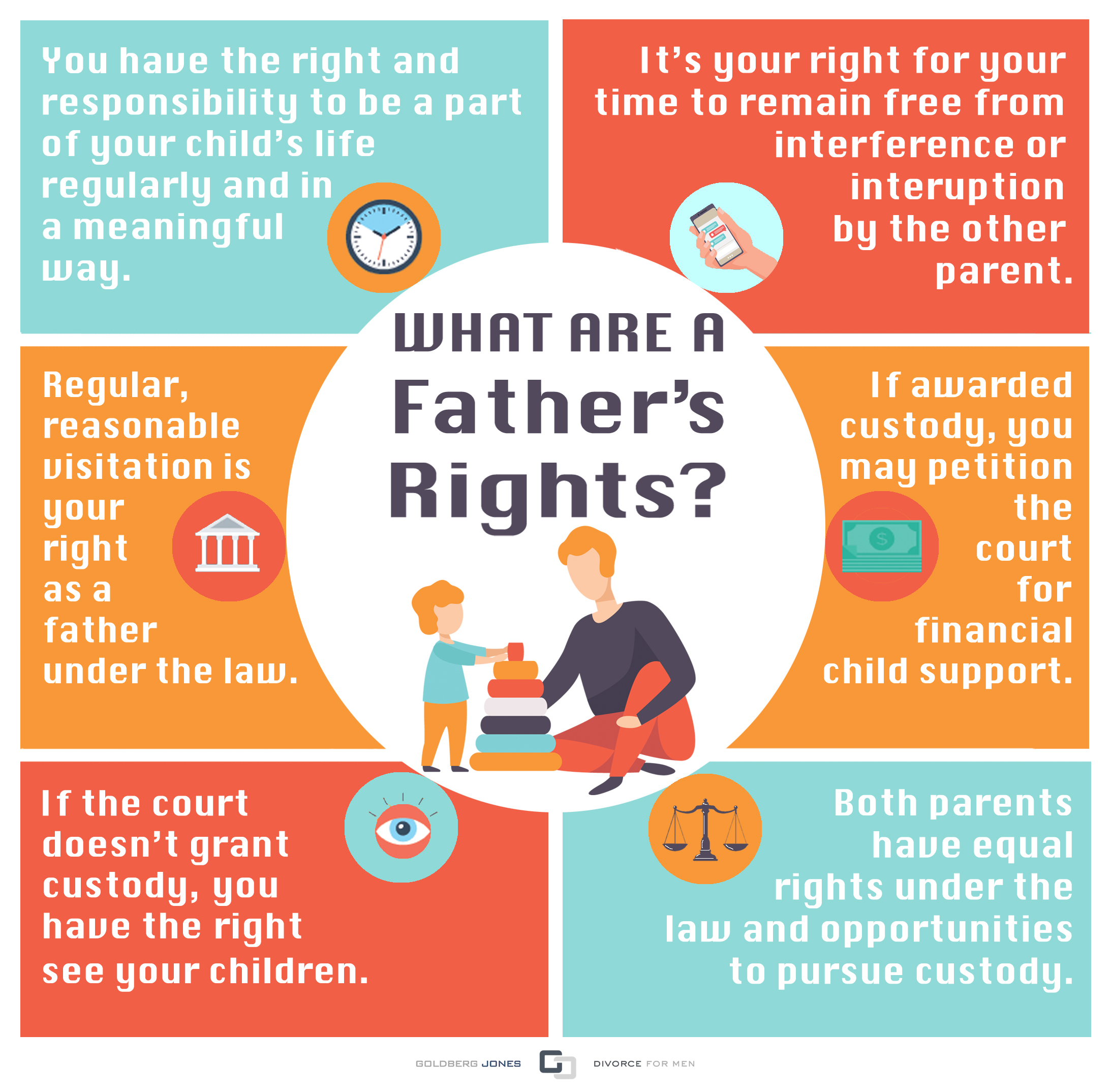
    • Barring extreme circumstances, you have the right and responsibility to be a part of your child’s life on a regular basis and in a meaningful way. Basically, should you and your spouse divorce, if it involves children, both parties have equal opportunity to remain fixtures in their lives.
    • Just like a mother, a father has the right to request primary guardianship.
    • If he does receive custody, he also has the right to petition the court for appropriate child support from his former spouse. This may be used to help provide for expenses like food, clothing, shelter, and other necessities.
    • If the courts don’t grant the father custody, he still has the right to see his children. This visitation will be reasonable and regular. In this scenario, you are also entitled to spend time with your kids free from interference by the custodial parent.

    Related Reading: Best Interest Of The Child

    How To Ensure Your Rights As A Father

    fathers' rights infographic
    (Opens in New Window)

    In recent years, there has been an increased emphasis, publicly and in the courts, on making sure that both parents play an integral part in a child’s life after divorce or separation. It’s important that you remain involved in the upbringing of your kids. However, you may have to take steps to ensure this happens.

    As already stated, you are equally entitled to custody during the divorce process. If you actively want primary custody, you have every right to pursue this goal.

    You may need to prepare and file a petition for custody, provide information about the parents and child, and ultimately wait for the court to decide on your request. Oregon law also requires that all such petitions include a parenting plan.

    When awarding custody, the court aims to serve the best interests of the child. To establish this, the judge examines a number of factors. This may include:

    • Your abilities as a parent.
    • Pre-existing relationships with your kids.
    • Stability.
    • Physical and emotional health.
    • Safety.

    If kids are old enough to have a preference, the court may take their testimony into account. However, if their wishes oppose their best interests, the court can ignore them.

    In short, don’t be passive. If you want custody of your children or significant visitation rights, take an active approach.

    It’s likely in your best interest to hire an attorney with experience working child custody cases. A lawyer will have insight into the process, as well as advice, both legal and practical, to lead to an optimal outcome for your case.

    Related Reading: Enforcement Proceedings: How to Protect Custody Rights

    The Rights Of Unmarried Fathers

    In some cases, it may be trickier to assert your rights as a father. For instance, if you and your child’s mother never married. In Oregon, however, unmarried parents have the same rights as their legally bound counterparts.

    If your paternity is established, and your name appears on the child’s birth certificate, you will be recognized as the legal father.

    As such, just like if you were married, you and the mother have equal legal standing in the eyes of the law. You have just as much right to pursue primary child custody as your ex, regardless of marital status. Should you be awarded guardianship of your kids, you also have the right to petition for child support.

    Similar to divorced or divorcing couples, the court considers factors like:

    • Income.
    • Ability to pay.
    • Custody schedule.
    • Need.

    These all figure into the amount. Even if you do not win custody, you will most likely still be entitled to regular visitation. The court will also likely order you to provide child support.

    Related Reading: Establishing Paternity In Oregon

    Ways To Help Your Custody Case

    You need to convince the court you’re best suited to be the primary custodian. It’s important to demonstrate your parenting ability and showcase what you bring to the table. With that in mind, here are some ways you can help your own child custody case.

    Work With Your Ex

    Like it or not, when you have kids, you’re going to have some contact with your ex.

    Unless the health or well-being of your children is in danger, you’ll have to work together as co-parents on some level. You may not like it, but bite the bullet and collaborate with your ex.

    Not only is it beneficial to the kids to have both parents involved in their lives, but this willingness to cooperate also helps your child custody case.

    Related ReadingParental Evaluations In Oregon

    Stay Part of Your Child’s Life

    It’s also vital to remain a part of your child’s daily life for a number of reasons. This strengthens the parent/child bond, it’s good for both of you, and it can help your case.

    Spending time with your children on a regular basis shows you are and want to stay an involved parent.

    Courts also try to avoid drastically shaking up a child’s routine when ruling on custody. When you’re already a big part of their life, it’s more likely to stay that way.

    Related Reading: Unmarried Parents’ Custody Rights

    Make Use Of Your Parental Rights

    We see it all the time. People claim to want custody but don’t take advantage of it when they have the chance. While a case is in progress, the court often issues temporary custody orders. These grant regular visitation and the like.

    Take advantage of time and opportunities the court gives you.

    This includes big, fun special events, but also regular things, like helping with homework and going to doctor’s appointments.

    It’s important for the kids that you’re present, but it also demonstrates you’re an involved parent who wants to be there for your children.

    Document Everything

    Two words can come in very handy in these situations: document everything.

    If your ex sends you an email denying you a scheduled visit for flimsy reasons, save it. The same goes for voicemails, instant messages, texts, social media posts, and any other form of communication.

    If you have concerns about your child’s safety in your ex’s care, document your reasons.

    Keep a record of the time you spend with your kids. That way, if your ex claims you’re not an involved parent, you can prove otherwise.

    Basically, whatever statements you make to the court about your ability as a parent, or your ex’s, collect as much solid evidence as you can to support your claims.

    Related Reading: Common Child Support Questions

    Don’t Interfere With Visitation

    By this point, there’s likely ill will between you and your ex. Divorce tends to leave scars. But it’s important not to use custody situations for revenge.

    If your ex has visitation scheduled, don’t interfere with it or stop it from happening.

    First off, recognize that it benefits your kids to have both parents in their lives. Meddling makes you look petty, but it also has a wider impact.

    If you complain about your ex hampering your own visitation, you can bet a judge will remember this you interfering with theirs. Acting like a rational adult only helps your custody case.

    Don’t Trash Talk Your Ex

    Again, you probably aren’t too fond of your ex right now. No one expects you to be best friends, but keep those feelings to yourself, especially around your children.

    Be there for your kids and serve their best interests. Don’t use them as pawns in your custody dispute or try to turn them against your ex. Not only it is unhealthy for them, but if you try to manipulate them, it can damage your cause.

    Focus on making yourself look good instead of making your ex look bad, you’ll get far more mileage out of that approach.

    Related Reading: Do Criminal Charges Impact Child Custody Cases?

    Hire A Child Custody Lawyer

    Child custody disputes often become heated. Tempers flare and people react emotionally instead of thinking things through. There are also tons of details and complicated laws that play into custody decisions.

    Because of all of this, it’s usually in your best interest to hire a child custody attorney, especially if your ex hired one. A knowledgeable professional helps keep things calm and guides you through the process.

    Related Reading: Enforcement Proceedings If Your Ex Won’t Follow The Parenting Plan

  • Mistakes Men Make In Divorce

    Over the course of the process of ending a marriage, things tend to get messy and complicated. There are a number of common mistakes made in divorce. Mistakes that damage your own case.

    In straightforward, low-conflict cases, things may progress smoothly. However, with forms to fill out, appointments to appear at, and many other moving parts, it doesn’t take much for problems to arise. That doesn’t even take flaring emotions into account.

    Mistakes Men Make in Divorce

    Men often make mistakes in divorce in a number of areas. It’s vital to know these common missteps and steer clear of easily avoidable problems.

    Ill-advised choices harm your cause in a variety of ways. You may miss out on assets in the division of property. Mistakes can impact spousal maintenance, child support, or even custody arrangements.

    What Not To Do

    Don’t Ignore Finances

    This should come as no surprise, but divorce is expensive. One of the frequent mistakes men make in divorce is ignoring finances. It costs money to file papers or respond to a motion. Then there are attorney’s fees.

    When preparing for divorce, put money aside so unexpected expenses don’t blindside you.

    Beyond that, you also have many other factors to consider, including:

      • Keep an eye on joint bank accounts or credit cards.
      • Make moves to establish your own individual accounts.
      • If you’re on your spouse’s health insurance, you need to find your own coverage.
      • Document all of your assets and debts.
      • Don’t forget about your financial paperwork. This includes bank statements, retirement papers, loan documents, life insurance policies, investments, and other similar documents.

    You have to submit this to the court anyway, so having it ready in advance saves time.

    It also gives you a clear picture of what you have. Too often, men think they have a handle on what they make and spend, only to have that come back and bite them.

    Related Reading: How Do Major Purchases Affect Divorce?


    Don’t Settle On Unfavorable Terms

    Even in the best of times, divorce is stressful and emotional. By the time you reach this point, you probably just want it to be over and done with as fast as possible.

    That’s a natural feeling. But it also leads people to damage their own divorce cases and is a common mistake men make in divorce.

    Too frequently, people agree to unfavorable terms in a settlement simply to get to the end. Dissolving a marriage hurts and the process takes a long time, but don’t settle just to speed things up. Take the time to consider what you truly want and go after it.

    Finances, child custody, spousal support, and more have huge impacts on your future. It’s important to take the time and get what you need from divorce.

    Related ReadingHow Long Does Divorce Take?


    Don’t Move Out Too Soon

    If your marriage is broken beyond hope of repair, it makes logical sense to move out of a shared home. However, while moving out seems like a natural choice, it can have serious long-term consequences you need to be aware of.

    In terms of custody, moving out may create the perception, true or not, that you’re abandoning your kids or that you’re not a dedicated parent. Children pick up on tensions at home and no children want to watch their parents fight.

    The urge to escape this conflict or alleviate the tension is natural, but it can also hurt your chances of getting custody down the road. The courts want to limit changes in a child’s life, so if you establish a precedent that you’re okay with minimal parenting time, that can come back on you.

    In terms of property division, moving out of a shared home can diminish your claim to it later. A house is likely the most valuable thing you own. Because of this, it’s also the most substantial piece on the table when it comes to splitting up assets.

    In regards to spousal support, when you move out, the bills still stay behind. Even after setting up a new residence for yourself, the court may presume that the amount you pay in both residences is financially viable and order you to continue to pay that amount, or something similar.

    Related Reading: Moving Out Too Soon, How Does it Negatively Affect Your Divorce?


    Don’t Be Passive

    Don’t be too passive in the divorce process.

    You may want to get this over and done as quickly as possible. It’s easy to agree to everything your spouse proposes and move on. After all, it cuts down the conflict and speeds things up.

    But that can harm your best interests and cause serious long-term financial consequences.

    The division of property, spousal support, and child custody all greatly impact the next step. Take the time to figure out what you want and fight for it when necessary.


    Don’t Argue About Every Asset

    The flip side of that coin is arguing about everything. This is one of the big mistakes men make in divorce.

    You may not want your ex to get anything and fight every step of the way. After years of marriage, you’re bound to have legitimate disputes.

    But some people fight out of spite or revenge. This gets expensive, wastes everybody’s time, and leads to more conflict and trouble than necessary.

    In general, the court divides property in an equitable fashion anyway. It may skew one way or another, but overall, the scales rarely tip severely to one side.

    Also, fighting about every individual item gets exhausting. You have way more important things to spend your energy on. Again, think about what you truly want and truly need. Pick your battles where they’re most important.

    Related ReadingWhat is Legal Separation and Is it Right for You?


    Don’t File For Divorce When You Aren’t Prepared

    Many think that being first out of the gates gives you an advantage and rush to file for divorce first. This does prove true in some cases, but not all. Depending on the situation, this strategy can cause people to seriously damage their own divorce cases.

    If you’ve prepared ahead of time, have everything in order, and feel ready, by all means, file the paperwork and start the divorce process. But too often, people don’t adequately prepare first.

    Organize your documents, set money aside, and have a clear plan of action. Establishing a solid foundation for your case benefits you far more than being the first to file. In the end, both sides have the opportunity to present their cases, and most of the time, any advantage to filing first is relatively minimal. Being prepared and organized has much more of an impact.

    Related ReadingDivorce And Filing Forms: How To Get Divorced In Oregon


    Not Consulting An Attorney

    It’s easier than ever to take a do-it-yourself approach to end your marriage. Online resources offer a step-by-step guide through the process. Just download the forms and with a minimum of fuss, you can file, pay the fees, and be on your way.

    While it’s ideal for certain situations, this DIY approach often leads people to damage their own divorce cases.

    This strategy works best in simple situations. Usually, this means shorter marriages without children and with little or no shared property. DIY often works well in these scenarios.

    But the longer a marriage, the more complicated the case, and the more complex the process will become. The potential to make mistakes increases, and it’s possible to do a great deal of harm without speaking with an attorney.

    One of the common mistakes men make in divorce is thinking they don’t need help. It puts you at an even greater disadvantage if your spouse has an attorney and you don’t.

    Related Reading: What is Pro Se Divorce? A Look At DIY


    Don’t Ignore Self-Care or Mental-Wellness

    Mental health is a prominent casualty of divorce. Men are more likely to suffer from depression in the aftermath. This despair often leads to a downward spiral—sometimes gradual, sometimes rapid.

    Dont Keep It To Yourself and Bottling It Up

    Often arriving with a potent cocktail of guilt, anxiety, uncertainty, grief, and even fear, divorce can be a sucker-punch to self-worth and self-esteem.

    Programmed to suffer in silence, many men carry this heavy weight on their shoulders alone rather than turning to friends, family, loved ones, or even professionals to help cope with these feelings.

    This frequently becomes a negative influence on overall mental and emotional health.

      • Men are more likely to suffer from depression following divorce.
      • Alcohol abuse, drug use, and other potentially detrimental behaviors spike in the wake of divorce as many men look to otherwise occupy themselves.
      • Following a divorce, suicide rates in men swell.
      • Men have been shown to be at an increased risk for a variety of health issues after divorce. This includes hypertension, heart disease, and even cancer, among other serious concerns.

    You don’t need to post every thought you have on Facebook—in fact, maybe stay off social media during the divorce—but it’s nice to have people to confide in. You may even want to look into seeing a therapist. Professionals offer helpful insight and advice in trying times.


    Your Lawyer Can’t Be Your Therapist

    Divorce lawyers are privy to intimate details about your life. Often things no one else knows, not even close friends. Too often this leads people to unburden themselves. This costs time and, importantly in this case, money.

    Your lawyer wants the best outcome for you and should empathize with your situation. But they’re not your confidant. Their job is not to offer emotional support and help you deal with personal problems.

    Talking to a therapist, counselor, or support group is beneficial and healthy. It’s often a key part of dealing with the complex emotions of divorce, recovering, and moving on.

    Also, a mental health professional has more tools and resources to help you through an emotional, turbulent time. They’re better equipped to help with what you’re going through. And likely less expensive.


    Don’t Act Out Of Spite

    Divorce often comes with wounded feelings, anger, and disappointment, all of which may well be justified. But acting out of spite and using this as a tool to get revenge is one way people damage their own divorce cases.

    More often than not, this makes the situation messier than it needs to be.

    It creates hostility, conflict, and additional problems. People often waste time and energy, and money, fighting about things that are in reality relatively minor.

    Divorce is a complex process with many roadblocks and problems that pop up. This list represents just a few common mistakes men make in divorce. Much of your future hinges on decisions you make here and now, so it’s vital to spend the time and effort to get it right.

    Related ReadingDo You Qualify For A Summary Dissolution?


    From Goldberg Jones Radio